

Amazon Just Built AWS for Logistics. The 3PL Industry Is Not Ready.
Why Amazon Supply Chain Services threatens every third-party logistics provider that mistook software lock-in for customer loyalty.
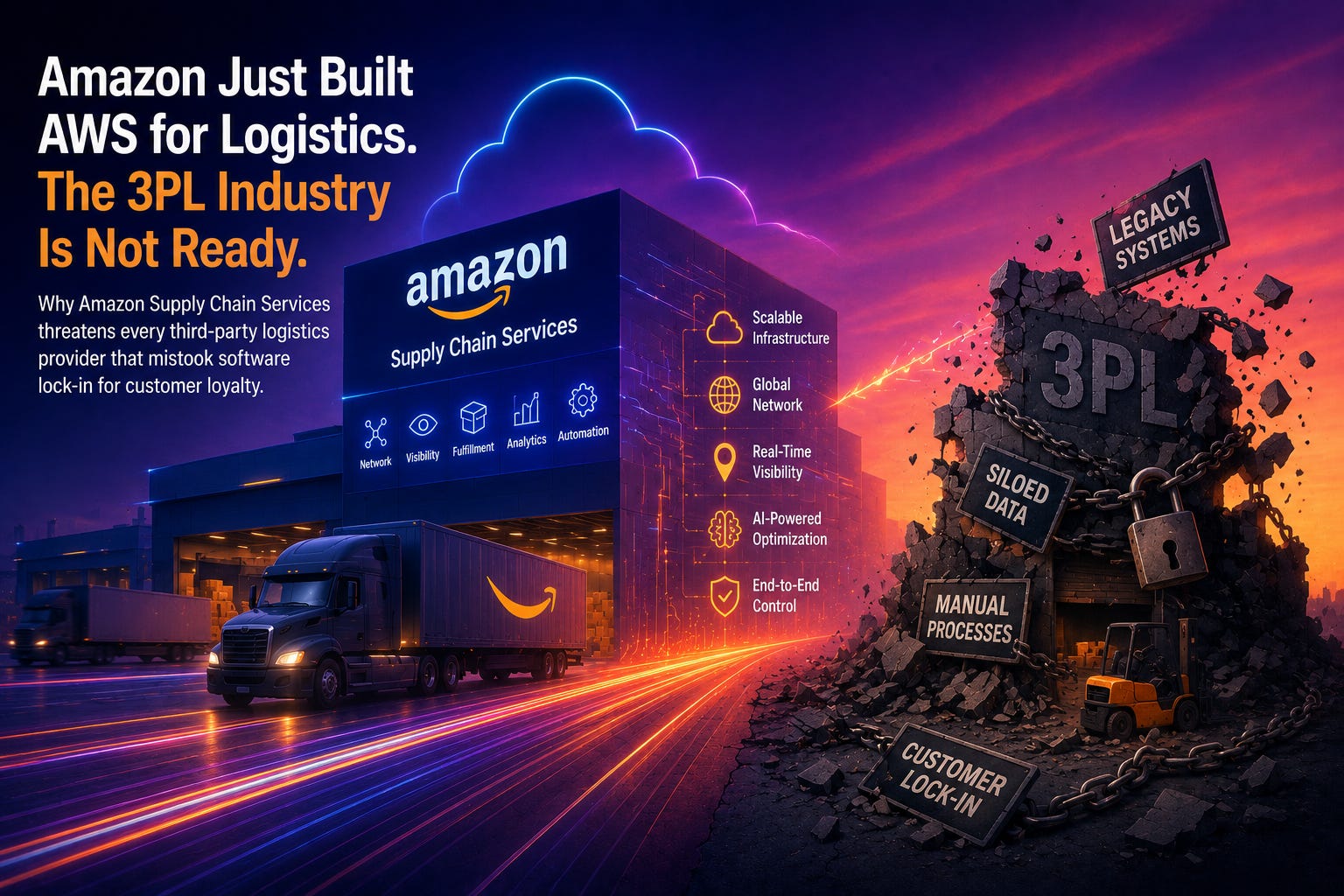
Amazon has formally launched Amazon Supply Chain Services, an integrated logistics offering that consolidates the company’s warehouses, transportation network, robotics, and orchestration capabilities into a single business unit accessible to external customers. The move had been telegraphed for years. The execution still caught most of the third-party logistics industry flat-footed. According to sources cited in the announcement, Amazon claims it can reduce customer logistics costs by 30 to 50 percent. Even if those numbers are inflated and the real range is 10 to 25 percent, the disruption is real.
The debate gained traction recently as some argued that 3PLs have been protecting themselves with the wrong moat. For years, the industry has relied on software switching costs, contractual friction, and customer inertia. Amazon does not run on Manhattan Associates, Blue Yonder, Oracle, or SAP. It built its own integrated execution engine from the ground up. The argument that customers are locked in by their TMS or WMS evaporates when the alternative is an end-to-end system that does not need any of those tools to function.
The debate drew enterprise logistics buyers, 3PL executives, technology founders, and supply chain consultants. The agreement on Amazon’s competitive threat was strong. The disagreement on how 3PLs should respond was sharper.
The Cohesion Problem
The most cited reframing came from Jonathan Dochod, a transformational operations leader. “Most 3PLs are still stitching together WMS, TMS, LMS, and robotics vendors and calling it integration. Amazon built the stack from the floor up, data, automation, transportation, and orchestration all running on one operating rhythm. That’s the real threat. Not the brand. Not the scale. The cohesion.”
His conclusion was direct. “3PLs that think customer stickiness comes from software lock-in are missing the shift. Customers don’t stay because switching is painful, they stay because outcomes are predictable. If Amazon can deliver lower cost, higher reliability, and a smoother transition path, the market will move.”
Colin Ricardo, Founder and CEO of Digital Optima, drew the same line. “The lock-in argument was always a fragile strategy. It mistakes switching friction for loyalty and those are very different things. The 3PLs most at risk are not the ones with the oldest systems. They are the ones that built their retention model around keeping customers dependent rather than keeping customers informed.”
Richard Chen, an AI builder formerly at TikTok and Meta, framed the broader logic. “The WMS lock-in argument has always been the weakest moat in logistics. When the alternative offers worse software, switching costs matter. When it offers better software plus end-to-end visibility from factory to door, those switching costs evaporate fast.”
The Specialization Counterargument
Not everyone accepted the steamroller framing. The most credible pushback came from Adrian Kumar, a supply chain thought leader and educator.
“Large 3PL operations are not plug-and-play fulfillment nodes. They are highly customized environments built around specific customer requirements, industry constraints, customer systems, and material handling solutions. Many are dedicated operations located exactly where the customer needs to be, beside a plant, near a specialized supplier base, or close to local store networks. Starting these up is a very different challenge than scaling a broad, standardized network.”
His central question deserves a direct answer. “How broad does Amazon go? Do they chase highly specialized dedicated solutions across various sectors like a large 3PL, or do they focus more on leveraging underutilized assets and expanding proven, repeatable models? The 3PL market is vast and highly bespoke.”
Patricia Au, Senior Director of Solutions Design at DHL Supply Chain, endorsed the point. The implication is that Amazon’s most viable initial targets are standardized, high-volume e-commerce and SMB workloads, not bespoke industrial operations with embedded customer-specific complexity.
The Exceptions Moat
Richard Chen identified the operational territory where 3PLs can still defend value. “The 3PLs that survive will be the ones that own the exceptions. Customs holds, damage claims, carrier disputes, regulatory compliance. Amazon can move boxes at scale, but the mid-market shipper dealing with a stuck container at Long Beach still needs someone who picks up the phone.”
That observation lands sharply. Amazon’s execution engine is optimized for predictable, high-volume flow. The work that breaks predictability, regulatory exceptions, supplier disputes, customer-specific service recovery, requires human judgment and relationship capital. 3PLs that abandon that ground to compete on standardized fulfillment will lose the standardized fulfillment race and the differentiated exception work simultaneously.
Ranjit Mathews, a Senior Director at Sutherland, drew the operating model conclusion. “Amazon may not eliminate 3PLs, but it will definitely expose the difference between a 3PL that manages activity and a 3PL that orchestrates outcomes. The real moat is no longer software lock-in. It is execution discipline, visibility, exception management, automation, and the ability to connect fragmented systems, people, assets, carriers, warehouses, finance, and customer experience into one operating rhythm.”
The Brand Discipline Problem
A second thread argued that Amazon’s biggest constraint may be the customers themselves.
Josh S., a fractional COO in health and wellness DTC operations, made the contrarian case. “Amazon won’t kill 3PLs, it’ll expose brands. Most brands aren’t built for the level of discipline Amazon requires. Most have loose forecasts. Last-minute pivots. Marketing driving ops in real time. That works when a 3PL is absorbing the chaos. It doesn’t work with Amazon.”
His conclusion was sharp. “They’ll win on cost, but a lot of brands won’t win inside their system because it will require marketing teams to entirely change the way they operate.”
Evan Charalampous, Head of Operational Excellence at GXO Logistics, agreed and extended the point. “That’s a valid point. It will also expose some 3PLs, the ones that don’t embrace change and manage processes like being back in the ‘90s.”
Blake Read, an account executive at a 3PL intelligence firm, made the same observation from the field. “Most brands say they want Amazon pricing but are unable to conform to Amazon requirements.” The 3PLs that survive may be the ones that specialize in serving brands too operationally messy to fit Amazon’s standardization requirements.
The Anti-Amazon Argument
Tim Higham, CEO of AscendTMS, raised the long-term market structure concern. “We all know how this ends. Amazon bankrupts all the mainstream 3PLs and then raises prices 30 percent once they control the market and the competition is dead. That’s what they did with their marketplace sellers. Everything was great, until it wasn’t, and now Amazon can do what they want with them because there is nowhere else to go.”
His warning was direct. “Let’s be careful what we all wish for. I love buying on Amazon. But it’s killing the very small US businesses we all love and rely on.”
Kyle Smith, a trucking and brokerage specialist, raised the customer overlap problem. “Most of the companies that would consider this product are currently, or will likely soon be, competitors of Amazon.”
That observation matters for any enterprise shipper evaluating Amazon Supply Chain Services. Outsourcing logistics to a competitor that may use the resulting operational data to refine its own retail strategy is a different commercial decision than outsourcing to a neutral 3PL.
The SMB Shift Comes First
Michael Kelley, Director of Logistics Procurement at HEINEKEN USA, mapped the likely adoption sequence. “Many 3PLs aren’t prepared for the scale and speed at which SMBs will shift to Amazon’s services, if the E2E digital plus physical network offering lives up to the billing. Once the proof of concept is validated across the SMB marketplace, enterprise shippers will follow. This doesn’t even touch on the number of enterprise FMCG shippers that leverage Amazon as a primary sell-through channel currently, which should already incentivize them to shift to the integrated ecosystem.”
The SMB and FMCG entry points matter. Once Amazon proves the cost reduction claims at scale on standardized workloads, the burden of proof flips. Enterprise procurement teams will need to justify why they are not using Amazon, not why they are.
Takeaways for Supply Chain Leaders
Three lessons run through the discussion. First, software lock-in is not a moat. Customers stay for predictable outcomes, not for switching pain. 3PLs that built their retention model on dependency rather than transparency are most exposed.
Second, exception management is the defensible ground. Amazon’s execution engine handles standardized flow at scale. The work that breaks predictability, customs, claims, disputes, compliance, is where human judgment and relationship capital still produce premium value.
Third, the cost claim changes the burden of proof. Whether Amazon actually delivers 30 to 50 percent savings or only 10 to 25 percent, enterprise procurement teams will increasingly need to justify why they are not benchmarking against Amazon Supply Chain Services. The default has shifted.
How is your supply chain function evaluating Amazon Supply Chain Services against your existing 3PL contracts?
Continue the discussion on Chain.NET, the global supply chain community, at www.chain.net. Ask questions, join events, and access exclusive resources.
 | A guest post by
|