

Can AI Replace Enterprise Planning Platforms? The IBP Debate Splits Supply Chain Leaders
A practitioner built a browser-based S&OP engine with Claude AI in a few sessions. Kinaxis, SAP IBP, o9, and Blue Yonder veterans push back on scale, audit, and integration.
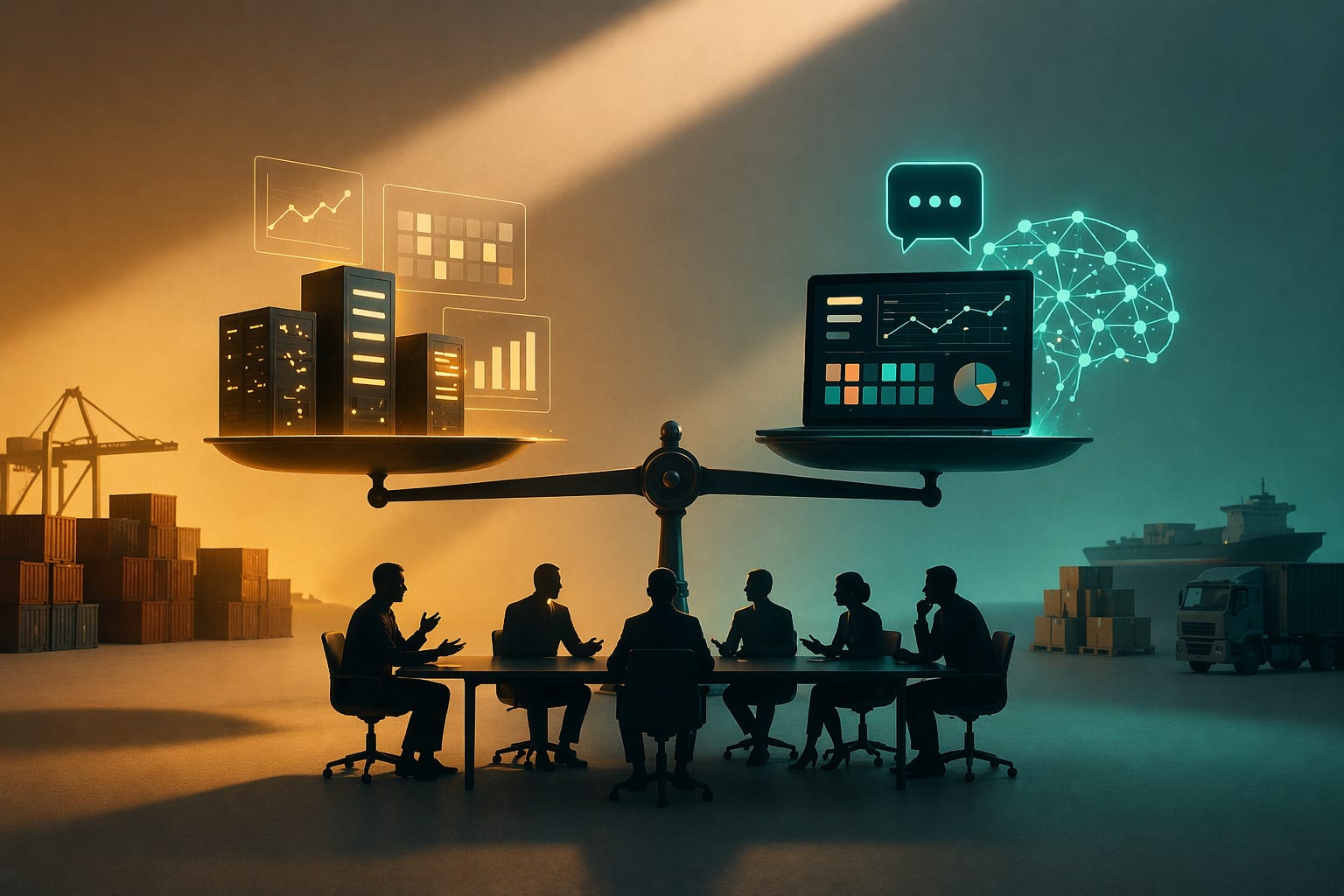
Four planning platforms dominate the enterprise market. Kinaxis, o9, SAP IBP, and Blue Yonder. Combined price tags run from $500,000 to $2 million a year. Time to first value sits between 12 and 18 months. Dedicated teams of three to eight full-time equivalents keep them running. And yet most planning teams still run S&OP in Excel. That is the gap the AI debate now hinges on.
The debate gained traction after Alain Matar, a Senior IBP Leader, Oliver Wight IBP Practitioner, and CSCP holder, posted on LinkedIn that he built a browser-based IBP planning engine from scratch using Claude AI. Nineteen planning steps. Nine forecast models. Thirty-five users. No vendor, no implementation partner, no six-figure license. “Just deep domain knowledge, a clear process design, and AI as the engineering partner.” The post drew planning architects, enterprise consultants, CEOs, and senior practitioners who split sharply on what the build actually proves.
The Knowledge Barrier, Not the Tech Barrier
The supporters argued that AI has collapsed the engineering gap that priced most companies out of real IBP.
Valerie LeBlanc, a digital supply chain transformation leader with an IMD MSc, framed the shift directly. “S&OP and IBP are not software features, they are decision rhythms.” For years, she noted, most organizations bought the tool, struggled with adoption, and fell back to Excel. “Not because people were not skilled, the gap between process complexity and implementation cost was simply too wide to bridge.” Her conclusion: “The technical barrier is gone, the knowledge barrier remains and that one cannot be licensed.”
Smita Giri, a Global Product Manager in Supply Chain, captured the same idea from the engineering side. “We’re shifting from an era of ‘how to build’ to ‘what to build.’ You can have a team of rockstar devs, but if the domain logic is fuzzy, the output will be too.” Her verdict: “Domain expertise is the new superpower.”
Aiden Heke, a data and insights leader, went further. “The emergent AI platform application category is real, the tricky work is understanding the data, the integration approach, and who will manage the application.” He added that this is “not the future, it’s the now.”
Jeremy Basckin pushed the disruption claim to its limit. “It’s game over for the magic quadrant and rightly said. We can implement an end to end planning and control system in 72 hours with far more capability.”
The Architecture Pushback
The critics accepted the compression of prototyping time but rejected the like-for-like comparison.
Rich Bradley, a consulting partner focused on digital reinvention, wrote the most cited rebuttal. “You asked Claude to rank your tool against the platforms it helped you build, using information you provided. That’s quite far from what I would call a benchmark.” He added that o9 and Blue Yonder implementations run 18 months because they span “cross-functional process design, ERP integration across multiple data sources, and organisational change management, it’s not because vendors pad their timelines.” For publicly listed companies, he noted, any planning tool touching financial forecasts has to carry “full audit trails, role-based access controls, and SOX-compliant data retention (seven years minimum under Section 404). That’s not optional and it’s not cheap to build.”
Sridharan M., an enterprise cloud solutions architect, sharpened the point. “A single HTML file can run planning logic. It cannot enforce audit trails, role-based access, concurrent user resolution, or real-time ERP/WMS integration. These aren’t vendor bloat, they’re non-negotiables at scale.” He flagged the deeper risk. “When your planning engine lives inside one person’s prompt logic, you haven’t eliminated vendor lock-in. You’ve created key-person dependency with no versioning, no test framework, and no institutional memory. That’s worse.”
Walter Reynders, an independent SAP IBP expert and trainer, landed the shortest challenge. “Honestly I don’t think it will take me 18 months to configure 19 planning steps and 9 forecast models in SAP IBP. How does your tool integrate with the rest of the IT landscape? Because that is 90 percent of the effort.”
Dr. Muddassir Ahmed, a supply chain consultant and newsletter publisher, drew the scope line. “$1 Billion + buys these complex planning software to achieve multi-site, Multi-legal entities, multi-echelons integrated planning. Which any Vibe Coded App on Claude cannot achieve as this point in time.”
Samuel Prashanth Yelety, a Principal Solution Architect for Kinaxis Maestro and OMP, added the execution question. “Demand planning is not just about simple forecasting, there are even management techniques, Product segmentation and New Product and Supply planning is closely connected with Distribution. Who would troubleshoot issues when the person developing cannot debug the code?”
The Enhance, Not Replace Argument
A third camp rejected the binary framing entirely.
Ash Uchil, a supply chain innovation and decision intelligence leader, proposed the most quoted compromise. “I don’t see Claude replacing these applications but enhancing them much like ServiceNow boldly adopting and embedding LLMs to make their products better. The winning model in the market may not be AI replacing SAP IBP or Kinaxis. It may be AI enhancing those environments by sitting above them, connecting across them, and embedding practitioner intelligence into day-to-day decisions.”
Kannan Ayyar, Chief Growth Officer at TADA, redirected the debate to execution. “The planning gap is real. But the harder problem isn’t building the plan, it’s executing against it. Most manufacturers I talk to have Kinaxis or o9 and still run S&OP in Excel because the system tells them what broke, not what to do about it in the next 4 hours. That’s the unsolved problem.”
Saurabh Pandey, a Lead eOps at L’Oréal India, surfaced the human layer. “Most IBP conversations focus on data, but very little on human behaviour uncertainty. In reality, biases like sales optimism and supply side risk aversion, combined with misaligned incentives to push sales often drive bigger deviations than data or forecasting gaps.”
Takeaways for Supply Chain Leaders
Three lessons emerge. First, AI has shifted the bottleneck from syntax to domain depth. The leaders who can architect their own planning cycle now have a new lever.
Second, enterprise-grade requirements still matter. Audit trails, role-based access, ERP integration, and SOX compliance do not disappear because the code was faster to write.
Third, the most credible path forward may not be replace or build. It may be AI sitting above existing platforms, embedding practitioner intelligence into daily decisions while systems of record keep running.
How is your organization testing AI-built planning tools against the governance, integration, and scale standards your business actually needs?
Continue the discussion on Chain.NET, the global supply chain community, at www.chain.net. Ask questions, join events, and access exclusive resources.
 | A guest post by
|