

Category Management, Procurement, and Purchasing Are Not the Same Job. Here’s Why It Matters.
Role confusion is driving salary disparities, misaligned technology investments, and strategic failures across the supply chain profession.
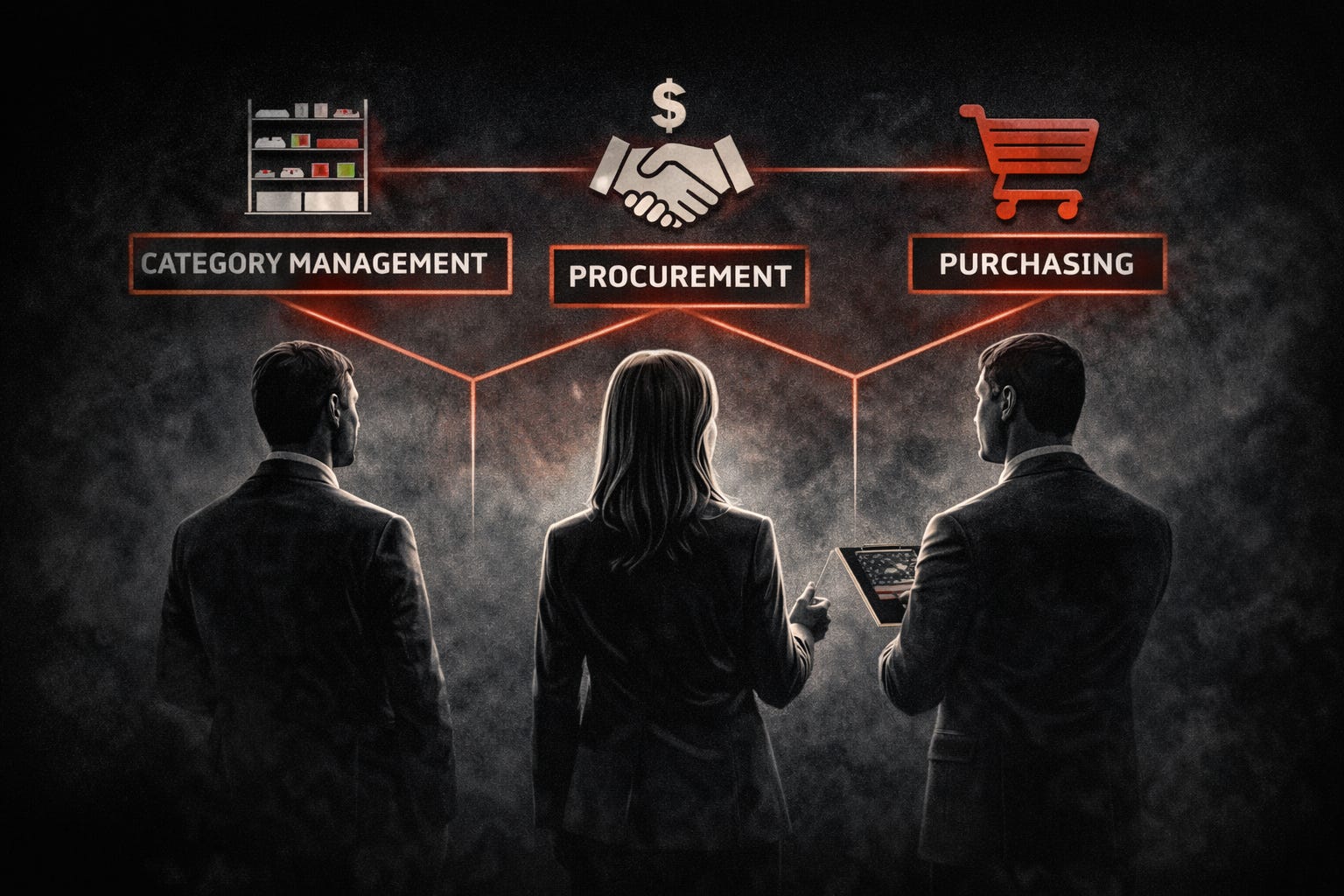
The supply chain profession has a terminology problem. Three distinct functions, Category Management, Procurement, and Purchasing, are routinely conflated in job descriptions, organizational charts, and technology platforms. The result: salary chaos, undervalued professionals, and software that solves the wrong problems.
A recent framework breaking down the differences across eight dimensions, from triggers to time horizons, sparked intense debate among practitioners about whether the distinctions matter or whether modern realities have rendered them obsolete.
The answer, according to dozens of supply chain leaders who weighed in, is that the distinctions matter more than ever.
Mark Strange, a supply chain strategist focused on operational resilience, framed the core issue. “Purchasing, Procurement, and Category Management don’t just differ in scope, they operate at different layers of enterprise design,” he wrote. “Purchasing executes transactions. Procurement governs commercial control. Category Management shapes future economic advantage.”
He identified the structural problem many organizations face. “Confusion arises when organisations expect strategic outcomes from functions positioned purely for execution. Structure determines outcome long before capability does.”
The framework draws sharp lines between the three roles. Purchasing responds to low stock levels and urgent operational needs, asking “What do we need to order right now?” Its value lies in speed and agility. Procurement handles strategic projects, supplier discovery, and contract renewals, focused on aligning sourcing decisions with long-term organizational goals. Category Management tracks retail trends, supplier consolidation, and product lifecycle needs, driving competitive advantage through market insight and category expertise.
The time horizons differ dramatically: Purchasing operates short-term and reactively, Procurement works medium to long-term, and Category Management requires continuous long-term optimization.
Clarice Camacho, who leads global energy procurement and risk management, described the organizational dysfunction that results from blurring these lines.
“Titles like Buyer, Category Manager, Procurement Manager, and Contract Manager are often used interchangeably, until expectations start clashing and performance gaps appear,” she wrote. “Procurement is not one job. It’s a spectrum of specialised disciplines.”
She catalogued the consequences. “When roles are blurred: Tactical buying is mistaken for strategic sourcing. Negotiation is confused with category strategy. Contract administration replaces supplier relationship management. Risk management becomes reactive.”
The compensation implications are significant. “The result? Misaligned expectations, frustrated teams, and compensation that doesn’t match impact, with some roles underpaid and others overpaid.”
Strahinja Jovanovic, a supply chain and inventory expert, highlighted how the different “X-factors” for each role create inherent tensions. “In fast operations, ‘speed and agility’ (Purchasing) actively undermines ‘market insight’ (Cat Man),” he observed. “Same person can’t optimise for both, one always sacrifices for the other.”
Mohammad Indratama, a procurement and supply chain leader in mining and energy, explained the cognitive challenge. “Mixing these roles into one will inhibit what each role wants to achieve. Imagine at any time during the day, your strategic long-term thinking (Category Management) gets interrupted by an urgent request (Purchasing) or a stakeholder call for technical requirement alignment (Procurement), the brain simply cannot adjust that quickly.”
The confusion extends to technology. Alice Muyendekwa, a purchasing and supply chain student, connected the dots between role confusion and failed software implementations.
“This explains a lot about why Procurement Tech often misses the mark,” she wrote. “If a platform is built for quick purchasing processes but sold to a Category Manager who needs Market analysis, the ROI is never going to align. Using the same titles for three completely different value sets creates confusion in operational efficiency.”
Anthony Ibekwem, an IT procurement consultant, confirmed that blurred boundaries persist across organizations. “In reality, many organisations I encounter blur these lines. Category strategy, procurement projects, and day to day purchasing sit in the same workflow with the same KPIs.”
Yet some practitioners argued that organizational reality has moved beyond clean distinctions.
Carolina V., a strategic procurement specialist with 17 years of experience, pushed back on the neat categories. “Today a procurement specialist is doing all these jobs in one,” she wrote. “An operational is doing also strategic and category/vendor management and a strategic on top of vendors selection/management, contracts negotiation and costs analysis and reduction is also handling operational escalations, supply chain issues and MDM like inventory stock, forecasts, processes update and much more.”
She suggested the boundaries have dissolved out of necessity. “The times when operational was doing just operational and strategic just strategic are gone plus it’s good to know the big picture and manage, analyze entire procurement activities accordingly and as one!”
Matthias Svetic, a communication advisor, argued that clarity in role definition enables organizational effectiveness. “Clarity in roles creates clarity in value; when Category, Procurement, and Purchasing are defined with intention, organisations gain strategic focus instead of internal friction.”
Camacho emphasized that each function requires distinct capabilities. “A Buyer executes. A Category Manager shapes strategy. A Procurement Business Partner drives commercial alignment. A Contract Manager governs performance and risk. Each requires different skills, experience, and influence.”
She identified the systemic failure. “Yet many organisations bundle them into one function, one title, one pay band. This isn’t just an HR oversight, it’s a structural issue that weakens capability, limits career progression, and reduces procurement’s strategic value.”
David Wicker, an entrepreneurial sourcing professional, noted that some academic programs do teach these distinctions. “Memphis did a phenomenal job preparing me for the world of procurement. Which included defining the nuances of the spectrum of roles and functions.”
Calvin Lyons, an interim procurement officer and transformation leader, suggested the framework deserves broader organizational discussion. “This slide deserves a ‘Lunch & Learn’ discussion,” he wrote.
Olga Catena summarized the framework’s core insight. “Category focuses spend categories long-term, Procurement owns end-to-end value, Purchasing is tactical buying.”
The debate reveals a profession at a crossroads. Some organizations continue merging roles out of cost pressure, expecting one person to switch between reactive purchasing, strategic sourcing, and long-term category thinking multiple times per day. Others recognize that each function delivers distinct value and requires different skills, compensation, and technology support.
Strange captured the stakes. “Distinction defines expectation, and expectation defines impact.”
For professionals navigating career decisions and organizations designing procurement functions, the message is clear: understanding which job you’re actually doing, or hiring for, determines whether the function delivers tactical efficiency or strategic advantage.
Confusing them guarantees neither.
Continue the discussion with procurement and supply chain professionals on Chain.NET.
 | A guest post by
|