

How AI Will Turn Supply Chain Leaders Into Founders
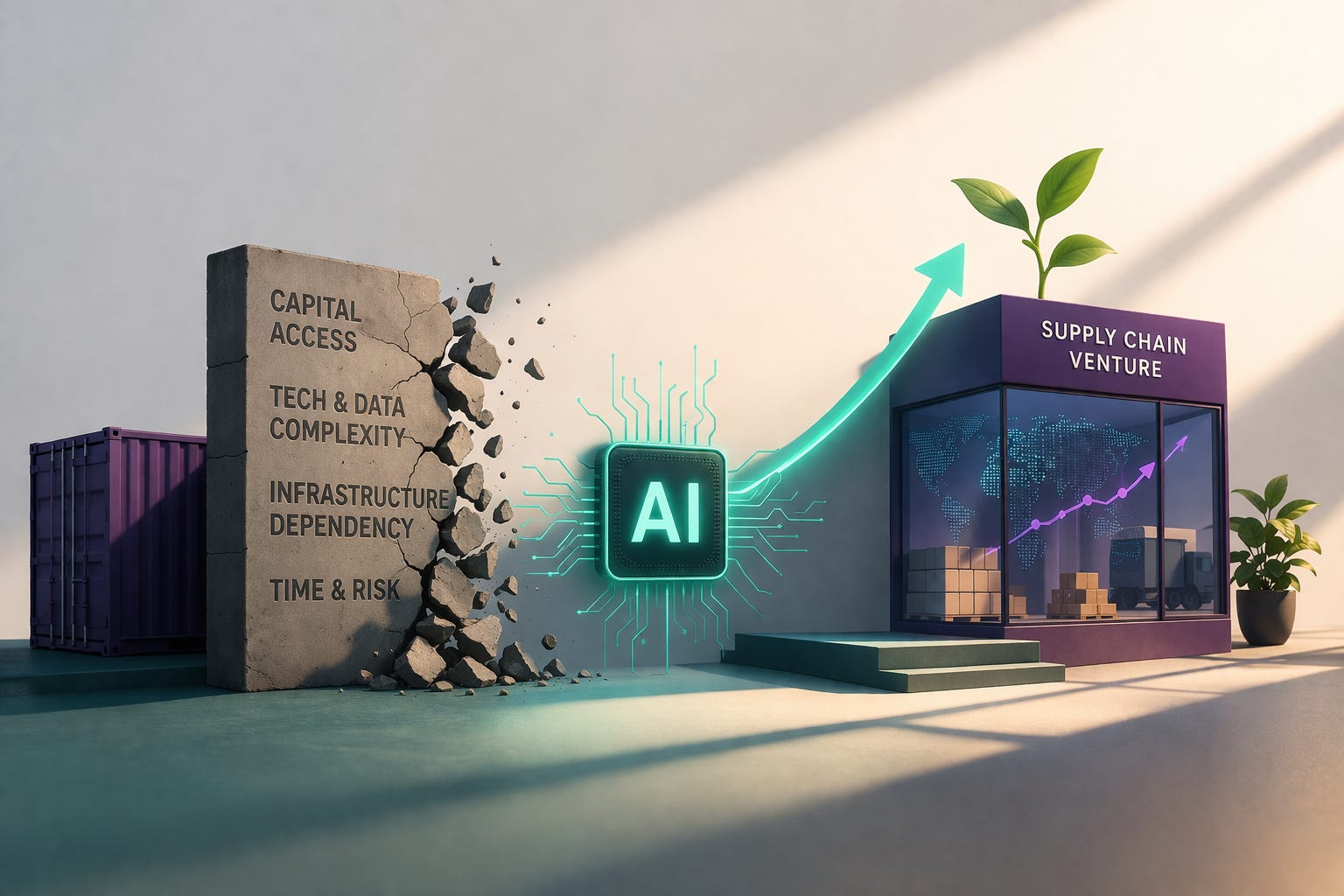
The traditional barriers to building a supply chain business are collapsing. Procurement and logistics professionals now have the tools to start ventures with minimal capital. The only question is whe
A procurement director manages spend across 500 suppliers. A logistics manager optimizes routes for a distribution network. A supply chain analyst forecasts demand for a manufacturer.
These are good jobs. They have salaries, titles, and security.
But increasingly, supply chain professionals are asking a different question: Why work for someone else’s supply chain when I can build one for others?
AI is making that transition possible in ways it wasn’t five years ago.
The traditional barriers to starting a supply chain business - specialized expertise, capital requirements, technology infrastructure, industry gatekeepers—are collapsing. A procurement professional with deep knowledge of supplier risk can now build an AI-powered risk monitoring tool without hiring engineers. A logistics expert can create an optimization platform without massive infrastructure investment. A demand planner can launch a forecasting service without building proprietary algorithms.
The gatekeepers are disappearing. The tools are democratizing. The moment is now.
Why Supply Chain Leaders Are in a Unique Position
Supply chain work is uniquely suited to founder transition because the domain expertise is the moat.
A technology founder must learn both code and business. A supply chain founder already understands the problem deeply. They know where suppliers fail. They understand the cost of inventory mismanagement. They’ve experienced the friction in procurement workflows firsthand.
What they lacked—the ability to build technology quickly—AI now provides.
A procurement professional can describe their ideal supplier risk assessment tool to Claude or another AI system. The AI builds it. They test it with their network. They refine it based on feedback. Within weeks, they have a prototype. Within months, they have a customer.
The capital requirement drops from millions to thousands. The timeline compresses from years to months. The expertise requirement shifts from “know how to code” to “know supply chain deeply.”
Specialized expertise becomes the differentiator. Gatekeepers lose power.
The Three Paths Supply Chain Professionals Take
Path 1: Build Tools for Your Industry. A logistics professional creates an AI agent that optimizes delivery routes and reduces fuel costs by 15%. They package it as a service and sell it to regional carriers. Revenue potential: $50,000-$500,000 annually depending on market size.
Path 2: Become a Specialized Consultant. A CSCO with 20 years of experience uses AI to accelerate her consulting practice. She builds diagnostic tools, assessment frameworks, and benchmarking models. She packages her knowledge as services backed by AI-powered analysis. Her effective hourly rate doubles because AI handles the data processing and analysis.
Path 3: Solve a Niche Supply Chain Problem. A procurement manager notices that mid-market manufacturers struggle with contract compliance. She builds an AI system that reads contracts, monitors compliance, and flags risks. She targets a narrow market—food and beverage manufacturers in North America—and captures 20-30 customers in year one.
All three paths share a pattern: deep domain expertise plus accessible AI tools equals viable business.
What’s Actually Changing
The old model required procurement and logistics professionals to stay in one company, climb the ladder, and retire as VPs or directors.
The new model offers a choice window. You can stay in your current role and use AI to expand your impact. Or you can take your expertise, build a specific solution for a specific problem, and create equity in your own venture.
Neither path is wrong. Both are now viable.
What’s changing is the gatekeeping mechanism. You no longer need:
Massive capital. An AI-powered supply chain tool can launch for under $50,000 in infrastructure and development costs.
Engineering expertise. You describe the problem. AI helps you build it. You don’t need to hire a CTO.
Venture capital blessing. You can bootstrap with customers and grow profitably without external funding.
Proven startup track record. Your supply chain expertise IS your credential.
What you do need:
Deep domain expertise. You must know the problem better than anyone else.
Clear customer understanding. You must know exactly who has the problem and how much they’ll pay to solve it.
Ability to communicate. You must articulate the problem and solution clearly.
Patience for sales. Selling to supply chain leaders requires relationship building and trust.
The 90-Day Founder Test
If you’re serious about exploring the founder path, here’s a realistic timeline.
Days 1-30: Validate the Problem. Talk to 20 procurement and logistics professionals about a specific problem you want to solve. Document exactly how they experience the problem today and what they’d pay to solve it. If you can’t find 20 people who care deeply, the problem isn’t big enough.
Days 31-60: Build a Prototype. Use AI tools to build a minimum viable solution. It doesn’t need to be perfect. It needs to demonstrate the core idea. Show it to five customers and iterate based on feedback.
Days 61-90: Secure Your First Customer. Don’t aim for perfection. Aim for a paying customer, even if they pay a modest amount. One customer validates the business model. Three customers validate product-market fit.
If you reach day 90 with paying customers and a clear path to more, you’ve validated the founder opportunity. You can then decide whether to go full-time or continue building part-time while maintaining your current role.
The Skills That Matter Most
As AI automates more of the transactional supply chain work—invoice matching, basic forecasting, routine vendor evaluation—the skills that create founder opportunity shift.
Strategic Judgment. Understanding trade-offs in supplier selection, network design, and risk management. These decisions require judgment that AI informs but doesn’t replace.
Stakeholder Relationships. Building trust with executives, vendors, and team members. This is where founders succeed or fail.
Pattern Recognition. Seeing problems that others don’t see yet. Noticing inefficiencies that others accept as normal.
Communication. Explaining complex supply chain concepts clearly to people who don’t live in supply chain every day.
These are the skills AI cannot replace. They’re also the skills that make founder opportunities real.
Moving Fast Before the Window Closes
The moment where supply chain professionals can leverage AI to build ventures is real but time-bound.
In two years, every consultant, tool vendor, and startup will be doing this. The competitive advantage of being early—having domain expertise plus AI capability before others do—will diminish.
Supply chain leaders with entrepreneurial instincts should move now. Not necessarily to go full-time as founders. But to test the opportunity. To validate customer need. To build proof of concept.
The cost of waiting is higher than the cost of experimenting.
Are you thinking about starting a supply chain venture?
What supply chain problem would you solve if you had the tools and capital to do it? Have you noticed inefficiencies in your industry that no existing solution addresses well? What’s holding you back from exploring the founder path?
Share your thinking in the comments. Your insights might be the spark someone else needs to move forward.
Join the Chain.NET community for strategic discussions on supply chain entrepreneurship, AI-enabled ventures, and the future of independent supply chain professionals. We host regular forums where procurement and logistics professionals share experiences building side ventures, consulting practices, and technology solutions.
Connect with peers exploring the founder path. Visit www.chain.net and check our events calendar at www.chain.net/c/events for upcoming sessions on supply chain entrepreneurship, building and scaling ventures, and positioning yourself for the next phase of your career.
 | A guest post by
|