

Nike’s C-Suite Overhaul Puts the COO in the Hot Seat. Is This the Future of Corporate Leadership?
The sportswear giant eliminates its CTO and CCO roles, signaling that integration and execution now trump specialized expertise at the top.
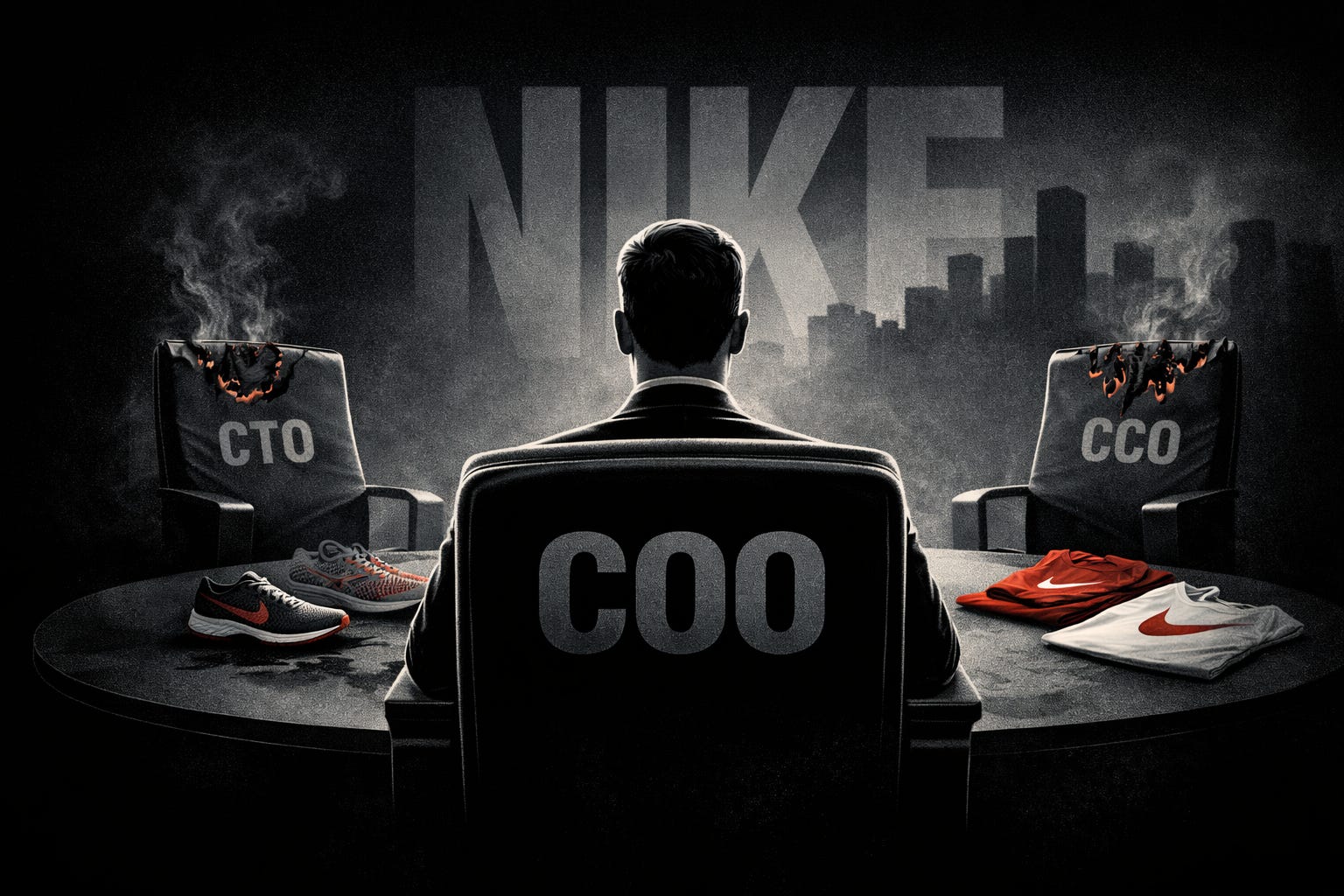
Nike just redrew the corporate power map. The sportswear giant eliminated two cornerstone C-suite positions and handed their responsibilities to a newly empowered Chief Operating Officer. The move has executives across industries debating whether this signals a broader shift in how companies should organize leadership.
The restructuring, part of CEO Elliott Hill’s “Win Now” strategy, removed the Chief Technology Officer role held by Muge Dogan and the Chief Commercial Officer position occupied by Craig Williams. Both executives are leaving the company.
In their place, long-time supply chain leader Venkatesh Alagirisamy, known as “Venky,” steps into an expanded COO role starting December 8. He now oversees supply chain, planning, operations, manufacturing, sustainability, and technology.
The changes don’t stop there. Regional heads for Greater China, EMEA, North America, and Asia Pacific/Latin America now report directly to Hill. Global Sales and Nike Direct (e-commerce and retail stores) now report to CFO Matt Friend.
The reaction from operations and supply chain executives has been swift and divided.
The Case for Consolidation
Dr. Francois Gourd, a strategy and executive management consultant, welcomed the return to simpler structures. “In the ‘old times’ there were only CEO, COO and CFO and it was working very well. The inflation of CXOs that came afterwards created silos, unnecessary structure, inefficiency, additional costs and confusion. The most efficient organizations are the simplest ones.”
His comment drew strong agreement, with nearly 80 reactions from executives who have watched C-suite proliferation complicate decision-making.
Dirk Fischer, COO at Huf Group, appreciated the validation of his role but raised a practical question. “Being a COO, this is of course nice to hear. But reading what you said, for what you need then a CEO? But one thing is also clear. It is the person that qualifies for these roles, not the title.”
Michael Stanier, a managing partner and brand builder, questioned why Nike ever diluted the COO role. “The surprising thing here is why Nike ever diluted the role of COO in the first place. It is the obvious C-Level operational integration role to enable fast decision-making and to deliver accountability.”
Technology Moves from Silo to Operations
The decision to fold technology under operations drew particular attention. Frederic Gomer, who analyzed the restructuring, framed the shift clearly: “Tech is no longer ‘IT’s job.’ It’s ops work. If tech touches service, lead time, inventory, delivery, allocation, store flow, forecast… it belongs with the people who run the system.”
Habeeb Rahman, a Group Deputy CTO, endorsed the logic. “Right move. Technology is the core driver of business. If COO does not understand technology, it becomes difficult to compete in the market.”
Nico Bac, founder of Digital Procurement Now and formerly at P&G, saw the move as part of a broader trend. “Technology is a real game changer and needs to be better embedded into every part of the business. There is still some way to go here for most big businesses.”
Marcela Escobar-Alava, a CIO and CDO, shared her perspective on integration. “I’ve always seen my role much more integrated into operations than a standalone tech silo. I love the less aligning part. Personalities and fiefdoms always get in the way of alignment and progress.”
The Skeptics Raise Valid Concerns
Not everyone sees the consolidation as wise. Ghassan Kabbara, a fractional CIO, warned of role overload. “This feels like the Peter Principle in action. Leaders are being loaded with responsibilities far beyond their core strengths. A strong COO now owns tech, sustainability, planning, supply chain and integration. That’s not operations anymore. That’s five professions in one.”
He extended the concern to the CFO’s expanded remit. “Same with the CFO: finance plus sales, customer experience and growth execution. This isn’t promotion. It’s sideways overload. Role saturation.”
Davide Petruzzi, founder of OrygoAI, shared similar reservations. “That looks risky. Too much stuff under one person. Plus tech is very fast moving and most COOs don’t have technical backgrounds. Let’s see if it works out well for them.”
Josep Ragull, a supply chain and ESG executive, questioned whether fewer voices improve decisions. “Not sure though how reducing the number of voices in the management team can help run the business better. Less debate, less opinions, faster decisions indeed, but better ones?”
He added a pointed concern about the commercial reporting line. “Putting Sales and Marketing under Finance is the best way to kill any creativity, innovation and disruption, which is what made Nike great.”
George Saives, a consulting executive, was more blunt about sales reporting to the CFO. “Sales reporting to the CFO! YIKES! CHIEF PREVENTION OFFICER.”
Integration as the Scarce Capability
Michael Allen, a global operations and supply chain executive, offered perhaps the most nuanced analysis. “This is less about org design and more about accountability. What Nike is signaling is that integration has become the scarce capability. When demand, supply, capital, technology, and sustainability are decoupled, performance degrades quietly until it breaks loudly.”
He continued, “Placing technology under operations isn’t a demotion of tech. It’s an admission that value is created where systems meet execution. Code doesn’t move product. Operating models do.”
Stefano Bianchetti, a senior supply chain lead, reinforced this view. “The point is not that the COO role is getting ‘bigger.’ The point is that someone has to own the real trade-offs when demand, capacity, technology and capital collide. When that ownership is missing, organizations fill up with functionally correct roles that are systemically irresponsible.”
Context Matters
Several executives cautioned against treating Nike’s move as a universal template.
Patrik Paňko, a commercial and omnichannel strategy specialist, emphasized timing. “This feels less like a universal org blueprint and more like a phase-specific decision. When scale, inventory risk and capital efficiency dominate, integration under a strong COO makes sense. In a growth or disruption phase, separating Commercial, Tech and Ops often creates more speed and tension, in a good way.”
Puneet Dua, an FMCG specialist, agreed. “If this OM is what Nike needs to turnaround, great for them. Others don’t copy paste. Find your own OM. Context is important.”
Bruno Pontinha, a senior client partner, noted the model doesn’t fit all industries. “This logic is not totally true for Telco. The CTO remains a key role in this industry as CSPs still deeply rely on the mobile and fixed network tech infrastructure that enables their services.”
The Execution Question
Sotiris Karababas, a senior business leader and interim supply chain executive, raised a critical implementation concern. “IT moves under the COO, and the press release promises ‘faster decision-making’ and ‘operational synergy.’ But let’s be realistic: A change at the top doesn’t guarantee a more efficient company.”
He continued, “The real impact depends entirely on the structure one layer below. If you install an IT Director between the technical teams and the COO, you haven’t shortened the loop. You’ve likely lengthened it.”
Ingo Winterhoff, a former Adidas executive, emphasized that execution requires more than restructuring. “Customer centricity, product obsession and proper inventory levels are key ingredients to lasting success. Executing this or any operating model successfully requires team play at the highest level.”
What This Means for Operations Leaders
Maria S. George, a global supply chain strategy executive, posed the question many are asking. “The faster now and more complex cycles ‘idea to market’ call for streamlined decisions and end-to-end ownership to best serve ever demanding customers. The BIG QUESTION is: do companies have ‘ready now’ COOs to take on the larger scope?”
Gabriele Tagliavia, a global COO, suggested the evolution continues. “Running the operating model is clearly the future and I would push it even more: running the operating model by making a clear separation between what is still human-led vs AI.”
The debate over Nike’s restructuring reveals a profession in transition. The COO role is expanding from operational execution to enterprise integration. Whether that expansion creates clarity or chaos depends entirely on the leaders who fill these seats.
As Colin Emberson, who scales complex multi-market businesses, summarized: “Running ops is table stakes. Owning the operating model is the job now.”
Continue the discussion with operations and supply chain leaders on Chain.NET.
 | A guest post by
|