

SAP’s Blockbuster Moment: Why the ERP Giant Faces an Existential Threat
Composable architectures and AI-driven platforms are breaking the monolithic ERP model while SAP doubles down on legacy strategy.
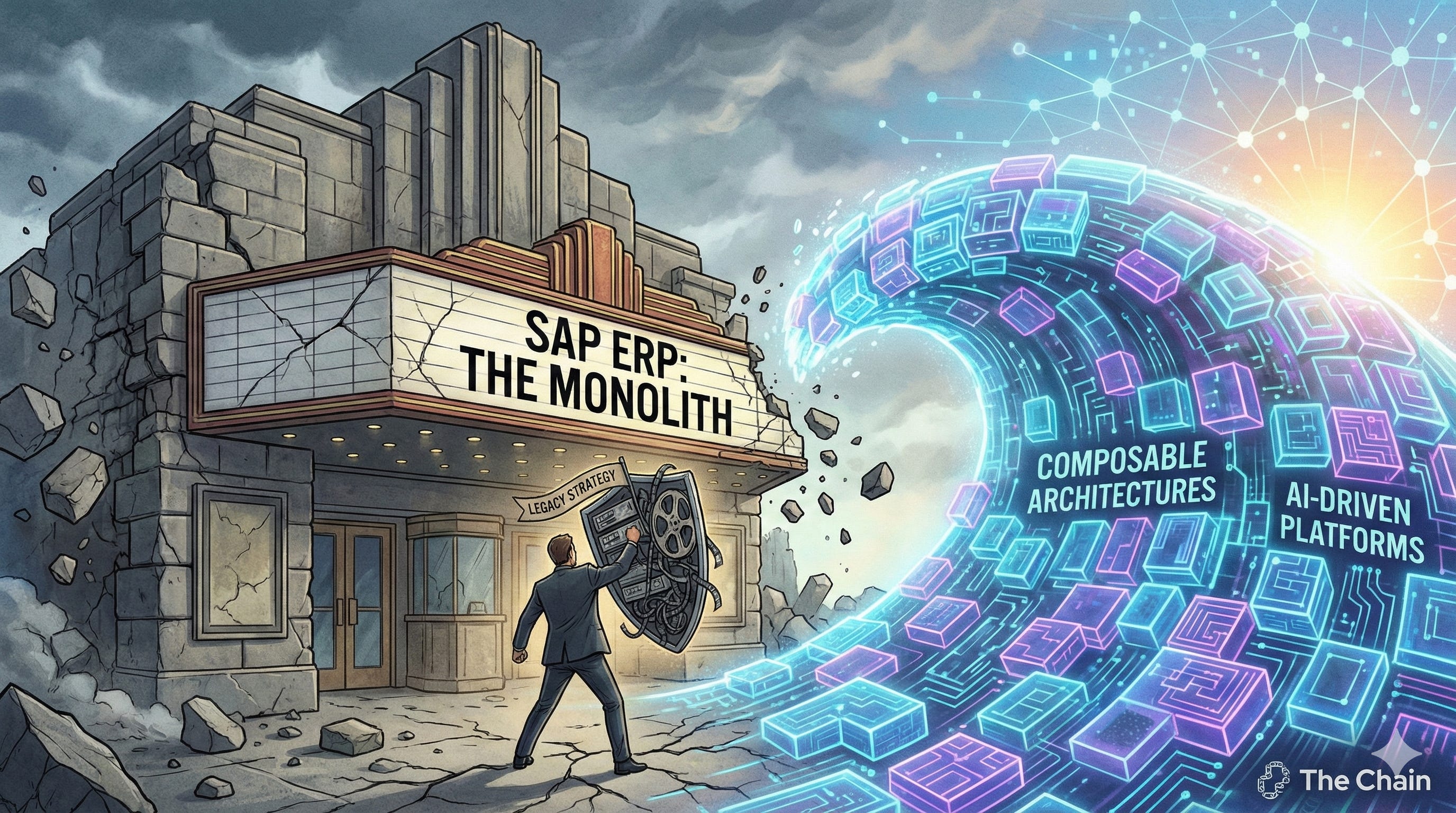
SAP dominates enterprise resource planning software with a market position that appears unassailable. The German software giant runs operations at thousands of the world’s largest companies. Its S/4HANA platform generates billions in recurring revenue. Competitors struggle to displace SAP once it embeds in an organization.
Yet Eric Kimberling at Third Stage Consulting recently compared SAP’s current trajectory to two iconic tech failures: Blockbuster ignoring streaming and BlackBerry dismissing the iPhone. Both companies dominated their industries until they did not.
The comparison provokes strong reactions. Some dismiss it as consultant hyperbole. Others recognize unsettling parallels. The central question matters more than the debate: will SAP adapt to the future or be overtaken by it?
The Composable Architecture Shift
The enterprise software market is moving toward composable architectures where organizations assemble best-of-breed components rather than deploying monolithic platforms. This architectural shift challenges SAP’s core business model.
SAP still pushes single-stack ERP implementations. The company positions S/4HANA as the comprehensive solution that handles finance, supply chain, manufacturing, sales, and human resources through integrated modules. This integration creates both value and lock-in.
Composable alternatives allow organizations to select specialized applications for each function and connect them through APIs and integration platforms. Financial planning from one vendor. Supply chain planning from another. Manufacturing execution from a third. Each component excels at its specific function.
Jakob Bent Smed, an independent advisor specializing in ERP readiness, observes the market shift firsthand. “I’m seeing the same shift as an independent advisor. Organizations are quietly moving toward more composable, flexible setups, with microservice-based ERP as a perfect example. They want speed, adaptability and less lock-in.”
The debate centers on whether integration benefits outweigh specialization advantages. SAP argues that tightly integrated modules eliminate data silos, reduce integration complexity, and provide unified governance. The integration depth accumulated over decades creates competitive moats.
Composable advocates counter that specialized applications deliver superior functionality, faster innovation, and lower switching costs. Organizations gain flexibility to replace underperforming components without replacing the entire stack.
Barry Preston at a digital strategy consultancy noted the pattern from his implementation experience. “Micro services sound great. They’ve been around for a long time now. The weak point in all of it is in the connections, the integrations needed to create a complete workflow, rather than just islands of functionality. I was implementing SMB systems back before SMB ERP was a thing. We sold individual best-of-breed systems, cobbled together with chains of data integrations, as a great selling point. Truth was, it was the only option we had.”
Yet integration technology has advanced dramatically. Modern iPaaS platforms, API management tools, and event-driven architectures reduce integration friction. What required custom code ten years ago now deploys through configuration.
Stephane Azoulay at NetSuite reframed the debate. “The composable versus monolithic debate often misses the point entirely. The question isn’t architecture for architecture’s sake. It’s whether your platform can genuinely evolve with your business without requiring a forklift upgrade every few years. I’m seeing something different emerge: platforms born in the cloud, built with a unified data model, designed to be extensible and AI-ready from the ground up.”
The Echo Chamber Problem
SAP operates within an ecosystem of partners and analysts whose business models depend on SAP’s continued dominance. Implementation partners build practices around SAP technology. Analysts cover SAP extensively because clients demand it. The ecosystem insulates SAP from uncomfortable market feedback.
Stefan Rask outlined how this manifests. SAP releases, renames, and repackages products faster than customers and consultants can absorb. SAP Cloud Platform became BTP. BW became Datasphere. Ariba became SAP Business Network. Constant rebranding creates confusion even among SAP employees.
The cloud transition accelerates without adequate customer preparation. SAP pushes RISE and GROW migration programs, AI tools, Industry Cloud, and sustainability applications at high speed. Releases arrive every few months. The learning curve steepens beyond what the ecosystem can support.
Multiple overlapping solutions exist for the same purposes. Automation, integration, analytics, and data management all feature competing SAP products. Customers struggle to understand what is strategic, what is optional, and what will be replaced in the next release cycle.
Thomas Wilson observed the result. “Core ERP? SAP is the king and no one can challenge that. However, their product portfolio has exploded out of proportion, that the clients and system integrators are completely confused, not just with regard to what has to be implemented or adopted but also the names of the products which keep changing every other day.”
Azoulay identified why this pattern persists. “When your ecosystem partners’ livelihoods depend on complexity and multi-year implementations, there’s little incentive to advocate for simplicity.”
This confusion serves SAP’s interests short term by creating consultant dependency and switching friction. Long term it erodes trust and opens opportunities for simpler alternatives.
The Quarterly Returns Trap
S/4HANA generates massive recurring revenue. Existing customers pay maintenance fees. Cloud migrations create services revenue. The business performs well by traditional metrics.
This success creates strategic paralysis. Meaningful pivots toward composable architectures or fundamentally new business models threaten current revenue. Executives optimize for quarterly results rather than decade-long market shifts.
Raphaël Delstanche identified the root cause. “The list of the S curve victims is very long: Compaq, MySpace, Xerox, Polaroid, Toys R Us, Borders Group, Nokia. I see at least three reasons for it: The fear of cannibalization and the cash cow dilemma, organizational inertia and strategic blind spots, culture and leadership resistance to change. But the top reason is the intense focus on quarterly returns management as a primary driver of corporate short-termism, which systematically undermines long-term investment, R&D, and genuine innovation.”
Clayton Christensen’s innovator’s dilemma plays out in real time. SAP’s current customers demand incremental S/4HANA improvements. New market segments want fundamentally different architectures. Serving existing customers well prevents serving future customers at all.
The company has resources to invest in new directions. But organizational incentives favor protecting existing revenue over cannibalizing it. Sales teams sell what they know. Partners implement what they have practiced. Customers resist change that does not leverage sunk costs.
The Competitive Reality
AI-native platforms and composable architectures are not theoretical threats. They are production systems winning competitive deals.
Workday disrupted human capital management by building cloud-native from inception rather than migrating legacy code. ServiceNow expanded from IT service management into enterprise workflow through modern architecture. Salesforce owns customer relationship management through continuous innovation and ecosystem building.
These companies do not compete on SAP’s terms. They do not promise comprehensive ERP suites. They excel at specific domains and integrate with whatever surrounds them. This focused approach enables faster innovation, better user experience, and more flexible deployment.
Duncan Jones identified a structural advantage SAP previously enjoyed. “One of the big drivers of SAP’s success was its Fifth Column of career SAP implementers whose careers depended on persuading their current employer to embrace SAP’s erroneous single source of truth religion. Unfortunately for SAP, many of those zealots are now retired or retiring.”
As experienced SAP professionals age out of the workforce, fewer advocates remain to champion SAP in client organizations. New generations of IT leaders lack emotional attachment to SAP and evaluate alternatives more objectively.
Horace Tee offered nuanced perspective. “SAP is a great solution for certain enterprise sizes, but it is not for everyone. Just like BMW is a great driving machine, but it doesn’t mean that everyone needs a BMW for the same driving experience. When SAP finds itself in this situation, it creates opportunities for many tier 2, local, and regional players to enter the market for localized ERP solutions.”
Why SAP Might Survive Anyway
The Blockbuster and BlackBerry comparisons have limits. Piyush Agarwal at LTIMindtree noted the fundamental difference. “BB and Blockbuster could be disrupted quickly because they served and were paid by individuals. SAP operates within complex large enterprise landscape not nearly as simple to break.”
Kimberling agreed. “If this were a consumer facing technology, my prediction would’ve already materialized. But since it’s a business focused technology, it’s going to take longer to see this shake out.”
SAP’s installed base creates enormous inertia. Replacing core ERP is massively disruptive and expensive. Most organizations will optimize existing SAP implementations rather than replace them. This installed base generates cash flow for decades even if SAP wins no new customers.
Richard Whittington, SAP’s global head of media and communications, pushed back on the narrative. “It’s important to always be reinventing yourself, being obsessive about delivering excellence and customer focus at scale. For Blockbuster it was their punitive late fees, BlackBerry didn’t embrace the ecosystem and got out-app’d, and for SAP had we stayed on-premise rather than having the courage to risk our existing business model you may have been right. But we didn’t.”
The cloud transition extends SAP’s relevance. S/4HANA Public Cloud represents genuine modernization even if the architecture remains fundamentally monolithic. Small and medium implementations now cost under one million dollars and deploy in months rather than years. This affordability expands SAP’s addressable market.
Kathiravan Subramaniam defended the innovation trajectory. “I don’t think the comparison is correct. SAP is already in this path of innovating to become AI native. Recent example is SAP Ariba moving to BTP.”
Risk-averse customers prefer proven platforms over promising startups. Compliance, audit, and governance requirements favor established vendors. Global footprints and local presence matter for multinational implementations. SAP advantages in these dimensions are real.
Rajender Gaddam questioned the premise. “SAP is reinventing and capturing back analytics and AI space. It appears every other month someone has a post about SAP is dead. Can you honestly believe that Fortune 500 companies can survive without SAP?”
The Future Scenario
Andres Vargas predicted how this resolves. “SAP will be the older mainframe that all big companies will use as record data and in front of that, many AI applications interacting with the customer.”
Kimberling agreed this represents the likely trajectory.
This outcome preserves SAP’s core business while acknowledging its architectural limitations. SAP becomes the system of record. Modern applications handle customer interaction, analytics, and innovation. Integration layers connect the two worlds.
Whether SAP views this as success or failure depends on perspective. The company maintains massive installed base revenue. But it surrenders the innovation layer to competitors. Strategic value migrates away from core ERP toward surrounding applications.
The Unanswered Question
Joselina Peralta at Stractix reframed the strategic challenge. “Even if SAP pivots, will their customers be structurally ready to move with them? Because here’s the reality: Composable tech doesn’t land in fragmented operating models. AI doesn’t scale inside siloed decision rights. And ERP upgrades don’t create transformation, they expose the lack of it.”
She continued. “This isn’t about SAP alone. It’s about the org’s ability to absorb, align, and act with or without legacy constraints.”
This insight exposes why SAP might survive despite strategic missteps. Customer organizations lack capability to implement composable alternatives successfully. They need integrated platforms not because integration is technically superior but because their organizational maturity cannot handle composition complexity.
SAP’s future depends less on technology strategy than customer evolution. If customer organizations build capability to assemble and govern composable architectures, SAP’s integration advantages diminish. If customers remain organizationally immature, SAP’s monolithic approach continues delivering value.
The market will decide through thousands of implementation decisions over the next decade. Some organizations will successfully adopt composable models and demonstrate superior agility and innovation. Others will struggle with integration complexity and retreat to monolithic simplicity.
SAP’s challenge is not whether to adapt. The challenge is whether adaptation happens fast enough and thoroughly enough to remain relevant when customer capability catches up to composable promise.
The warning signs are real. The outcome remains uncertain. And that uncertainty is precisely what should concern SAP executives most.
Looking for unbiased ERP and digital transformation guidance? Visit Chain.NET to connect with supply chain and IT professionals sharing real-world experiences with SAP, composable architectures, and enterprise transformation. The future is being decided now.
 | A guest post by
|