

SPAR’s Distribution Network Collapsed After an ERP Rollout. Here’s What You Should Know
A botched SAP implementation at one DC in South Africa triggered cascading failures across hundreds of stores. The US87 million loss proves that supply chain resilience isn't an IT problem...
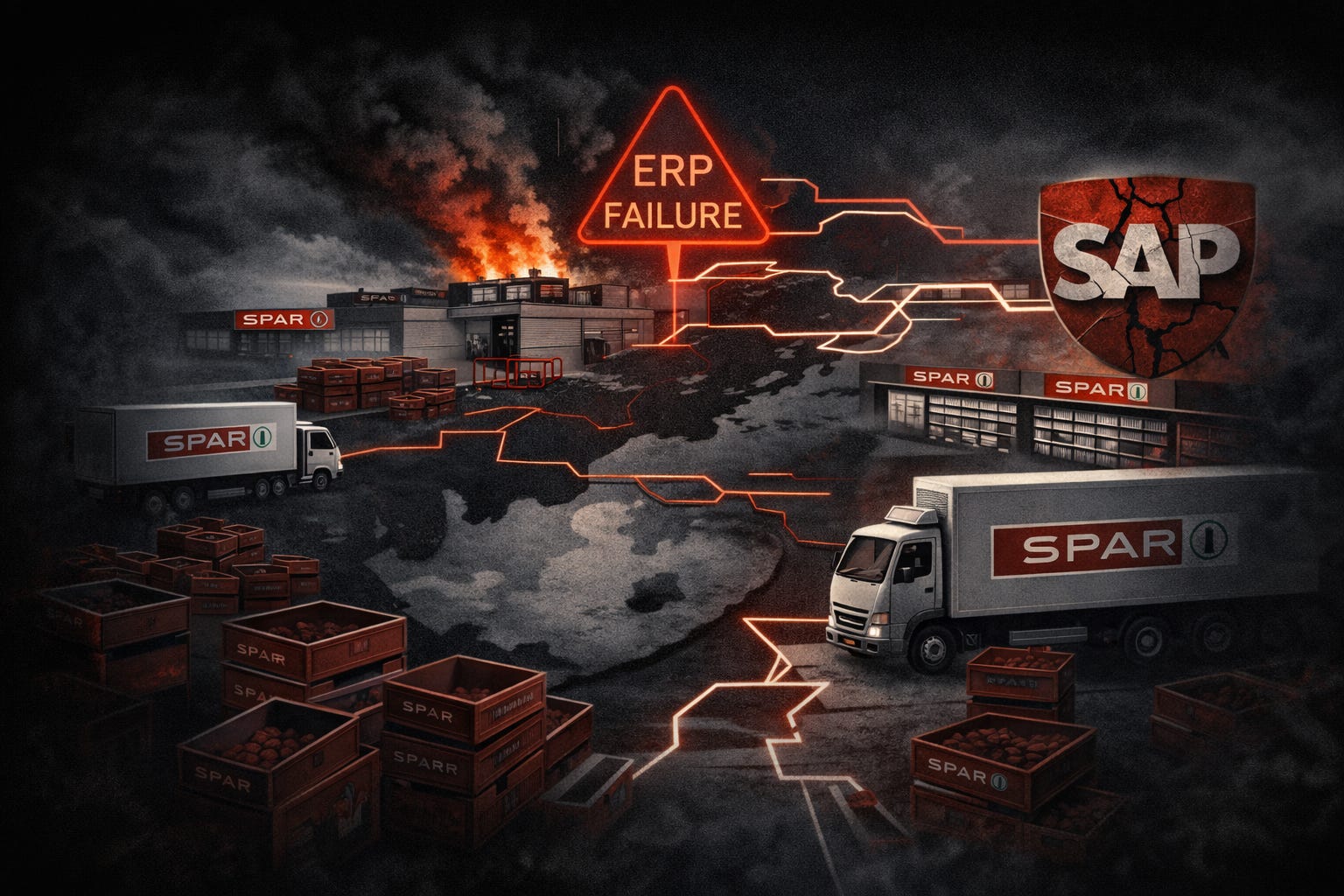
In early 2023, executives at The SPAR Group believed they had solved a problem. Their KwaZulu-Natal distribution centre, the beating heart of a network supplying 2,000 stores across Southern Africa, would finally run on modern software. The new SAP system promised faster order processing, better inventory control, and support for future growth.
By September of that year, the company was asking a different question: How did a software upgrade turn into an R1.6 billion ($87 million) disaster?
SPAR’s experience offers an unsettling cautionary tale for supply chain leaders. It also reveals something broader about how companies misjudge technology risk. The failure wasn’t purely technical. It was a supply chain crisis wearing an IT costume.
SPAR Group operates 6 distribution centres supplying goods and services to more than 2,000 SPAR stores across Southern Africa. The company maintains a 345-strong fleet of trucks and 400 trailers that travel 35 million kilometres a year. It is, in essence, a wholesale and distribution business masquerading as a retailer. When that distribution network failed, nearly everything downstream failed with it.
What went wrong at KZN was both straightforward and catastrophic. The SAP system went live without the data quality to support it. Supplier master records were incomplete. Lead time assumptions didn’t match reality. Inventory thresholds were guesses.
Distribution delays multiplied because the system couldn’t match purchase orders to supplier capacity. Stock visibility evaporated. Replenishment cycles broke. Warehouse staff, unable to trust the system’s logic, reverted to manual workarounds that were slow and unreliable. Empty shelves became the norm in hundreds of SPAR-branded stores.
By the time the system stabilized nine months later, the damage was irreversible. Suppliers had adjusted their expectations downward. Franchisees had watched their customers shop elsewhere. Competing retailers had captured market share that would take years to reclaim.
The R1.6 billion figure masks the real injury: a nine-month gap during which the distribution network that had worked for decades suddenly didn’t. That gap exposed a fundamental vulnerability in how SPAR’s supply chain was architected. There was no redundancy. No fallback. One node failed, and the entire system failed.
The financial aftermath was compounded by poor project discipline. SPAR reported R1.6 billion in lost turnover for the year, with the KZN region alone seeing about R720 million ($39 million) shaved from its profit. The implementation itself cost approximately R1.8 billion ($98 million). When the company later abandoned part of the investment, it wrote off R94 million ($5.1 million) in “asset under construction”—a public admission that executives had misjudged the program’s scope and complexity.
But the most damaging consequence came from outside the company’s walls.
The Giannacopoulos family operates 46 SPAR-branded stores. They are independent franchisees who depend entirely on the distribution centre for inventory. When the centre failed, they watched their sales evaporate. Customers drifted to competitors. In early 2026, they filed a lawsuit seeking R168-170 million ($9.1-9.2 million) in damages, alleging that SPAR’s system failure cost them margin on purchases and rebate schemes that depend on volume.
The lawsuit divides neatly into two claims: R142.9 million ($7.7 million) for lost gross profit and margin, calculated by comparing historical growth against post-SAP performance, and R25.8 million ($1.4 million) for losses on rebate schemes tied to purchase volumes.
What makes the lawsuit significant isn’t the dollar amount. It’s what it reveals. SPAR’s IT failure became a third-party liability. The financial impact cascaded beyond the company’s P&L into the pockets of franchisees who had no control over the technology decision. That relationship is now in court.
For supply chain leaders, this pattern should trigger immediate questions. What happens when your distribution system fails? Who bears the cost? If your franchisees, suppliers, or logistics partners absorb the damage, you now carry legal and reputational risk that no insurance policy covers cleanly.
SPAR’s mistakes were not unique to one company. They reflect patterns that appear across supply chain transformations. First, companies often treat ERP implementations as technology projects rather than supply chain redesigns. The steering committee includes IT leaders focused on uptime and bug counts rather than supply chain leaders focused on inventory accuracy and customer service. Governance becomes an afterthought.
Second, companies phase implementations poorly. They choose critical nodes—like SPAR’s main distribution centre—as go-live locations, betting that if the system works there, it will work everywhere. It’s the opposite of how supply chains actually work. One critical node failure cascades across the network.
Third, data quality gets treated as a project task rather than a prerequisite. Companies load legacy data into new systems and hope for the best. SPAR’s supplier master file was incomplete. Its inventory thresholds were calibrated for older workflows. The new system didn’t fix those problems. It inherited them.
The deeper lesson lies in risk management. A significant number of supply chain leaders report that their organizations are prioritizing large ERP system implementations, with a small percentage reporting that their advanced planning and scheduling implementations had failed and would need to be restarted.
Those failures don’t appear in earnings reports as single-line items. They appear as lost sales, margin compression, and damaged partner relationships.
For CSCOs and procurement leaders evaluating their own ERP roadmaps, SPAR’s experience suggests a different approach. Treat the system as a supply chain transformation, not a software project. Appoint a steering committee led by the CSCO with accountability for inventory accuracy, replenishment performance, and partner service metrics. Phase implementations through lower-risk distribution nodes and run pilots before touching critical infrastructure. Budget time and money for data quality work before go-live, not after. And model how the change affects every link in your network—franchisees, suppliers, logistics partners—and design mitigations before they become necessary.
The question SPAR executives should have asked in early 2023 wasn’t “Is our system ready?” It was “What happens if this fails?” That second question changes how you plan, how you test, and ultimately, how much damage you absorb.
Have you led a supply chain transformation that fell short? What would you do differently? Share your experience in the comments - your insights could help peers avoid the same costly missteps.
Join the Chain.NET community for strategic discussions on supply chain systems, distribution network design, and ERP implementation governance. Visit www.chain.net, and check our events calendar at www.chain.net/c/events for upcoming forums on supply chain risk management and distribution network resilience.
 | A guest post by
|