

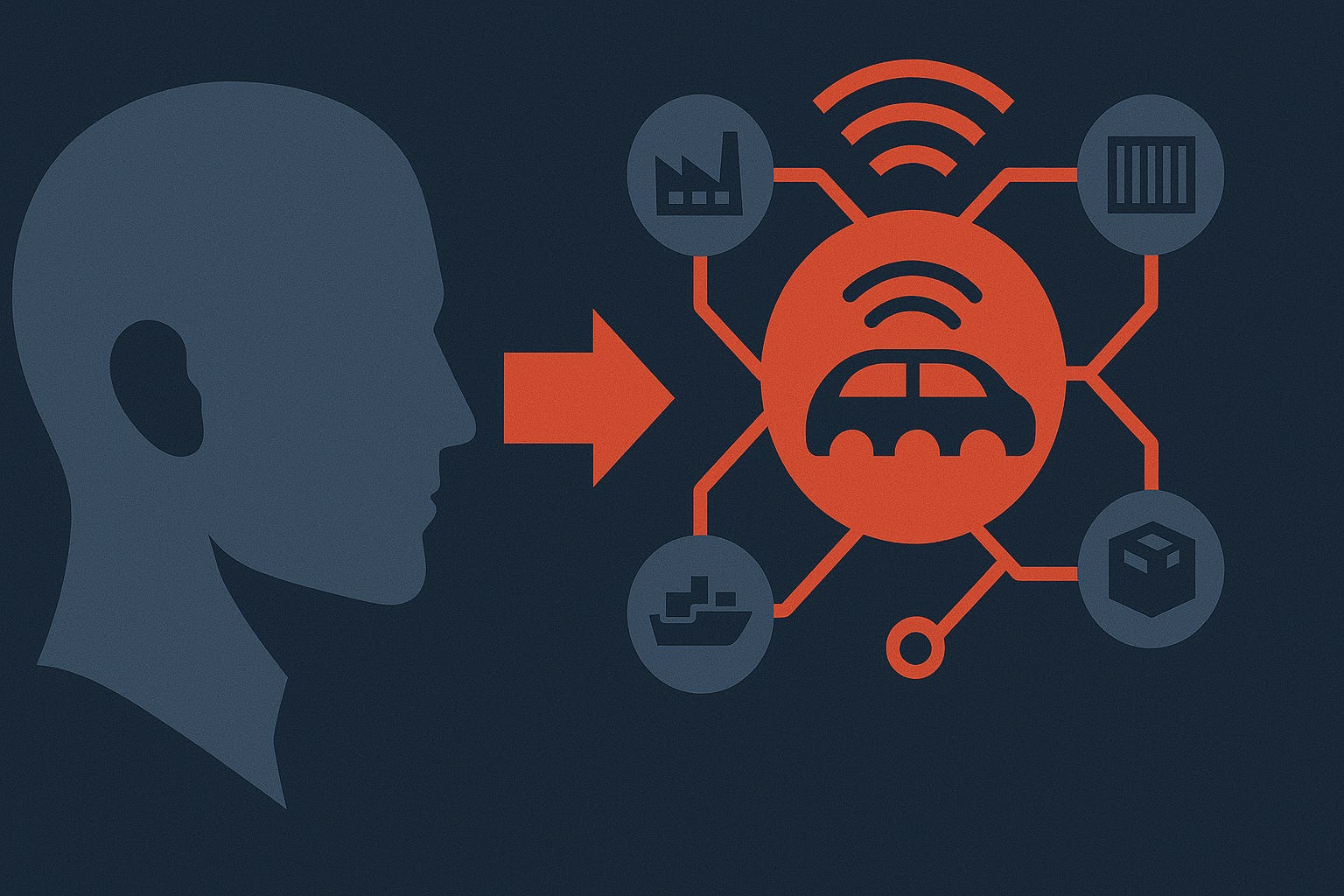
The supply chain operated the same way for decades. Humans analyzed data. Humans made decisions. Humans executed actions.
That model is breaking down.
Autonomous agents working within an agentic AI operating model now perform core supply chain assignments such as adapting to changing market conditions, rerouting shipments, negotiating with suppliers, and mitigating risks in real time—all without depending on people to make decisions or manually intervene.
This isn’t automation of routine tasks. This is delegation of judgment. And supply chain leaders who don’t prepare now will find themselves leading from behind.
The shift from suggestion to autonomous execution
For years, AI has been a co-pilot. It analyzed data. It recommended actions. Humans still made the final call.
Agentic AI is fundamentally different. It moves AI from passive insights to active execution. Agents don’t wait for human approval. They act.
Sixty-two percent of supply chain leaders recognize that AI agents embedded into operational workflows accelerate speed to action, hastening decision-making, recommendations, and communications. But here’s the critical part: that acceleration only works if leaders have designed systems where agents can act safely.
The data is clear about what’s coming. Seventy percent of executives state that by 2026, their employees will be able to drill deeper into analytics to support real-time analysis and optimization as AI agents automate operational processes, especially in procurement and dynamic sourcing.
And by 2025, agentic AI will autonomously make 15% of daily work decisions.
What supply chain leaders must do differently
Leadership in an autonomous supply chain requires a different skill set. You’re no longer directing execution. You’re architecting systems where agents execute within defined guardrails.
Seventy-six percent of CSCOs say their overall process efficiency will be improved by AI agents that perform repetitive, impact-based tasks at a faster pace than people can. But efficiency without governance is recklessness.
The real work starts now. Leaders need to design scalable ecosystems where individual agents can communicate, share context and orchestrate actions, using open protocols to enable these interactions with security and transparency.
Your data governance strategy becomes your competitive advantage. AI agents thrive on accurate, up-to-date data. Conduct audits to standardize and integrate procurement and supply chain information. Without clean data, even the smartest AI won’t perform well.
If you’re evaluating which agentic AI tools fit your supply chain architecture, explore Chain.AI—our curated directory of supply chain AI tools at www.chaine.ai. We maintain an up-to-date database of agentic AI solutions specifically designed for procurement, logistics, and supply chain operations to help you identify the right technology partners.
The timeline is accelerating
Consider what’s possible now. An agentic AI system can autonomously analyze real-time data from various sources, including inventory levels, supplier performance and market trends, then generate a comprehensive plan that adjusts procurement schedules, reallocates resources and communicates with suppliers to achieve timely deliveries—all while providing human managers with insights and recommendations for oversight.
Procurement processes that previously spanned over a month can be condensed into mere days.
This isn’t theoretical. Organizations are applying intelligent agents to automate workflows, tailor use cases and reduce the time and resources spent on administrative processes, with agents handling routine negotiations leading to faster contracts and more competitive pricing.
What changes for supply chain leadership
Your role is no longer directing people to execute tasks. It’s building systems where autonomous agents execute tasks reliably.
This requires new competencies:
Governance architecture. You must define what agents can decide autonomously and what requires human oversight. Embed governance processes, incident detection, audit trails and compliance checks within your agents’ lifecycles to ensure continuous oversight.
Multi-agent orchestration. No single agent can solve end-to-end supply chain complexity alone. Design a scalable ecosystem where your individual agents can communicate, share context and orchestrate actions.
Rapid decision-making on exceptions. Agents handle routine complexity. Humans handle novel problems. Your leadership must get faster at identifying when an exception needs human judgment.
Supplier relationship redefinition. Your negotiations with suppliers shift from transactional to strategic. AI agents can streamline the process of selecting suppliers by analyzing historical data, performance metrics, financial stability and market conditions, while your team focuses on relationship development and strategic partnership decisions.
The window for preparation is closing
Organizations that implement agentic AI in 2025 and 2026 will gain two-year advantages over those waiting until 2027 or 2028. By then, the baseline will have shifted.
Autonomous AI agents are already reshaping procurement and supply chain operations. By automating tasks, enabling real-time decisions and fostering better collaboration, they’re empowering businesses to tackle complexity like never before.
The question for supply chain leaders is not whether to prepare for autonomous agents. It’s whether you’ll lead the transition or manage the disruption after your competitors have already moved.
What’s your agentic AI readiness strategy?
Are your supply chain systems designed for agent autonomy? Do you have governance frameworks in place for autonomous decision-making? How are you rethinking your team’s roles as agents handle operational execution? Share your thoughts in the comments. What’s your biggest concern about autonomous supply chain agents?
Join the Chain.NET community for strategic discussions on autonomous supply chains, agentic AI implementation, and leadership transformation in procurement and logistics.
We run regular panels and expert discussions on this exact topic—bringing together supply chain leaders who are building autonomous systems right now. Connect with peers navigating this evolution and learn from real-world implementations.
Explore the latest agentic AI tools and solutions in our Chain.AI directory at www.chaine.ai - your resource for staying current on supply chain AI innovation.
Visit www.chain.net to join the conversation, and check our events calendar at www.chain.net/c/events to join upcoming panels on agentic AI and supply chain leadership.
