

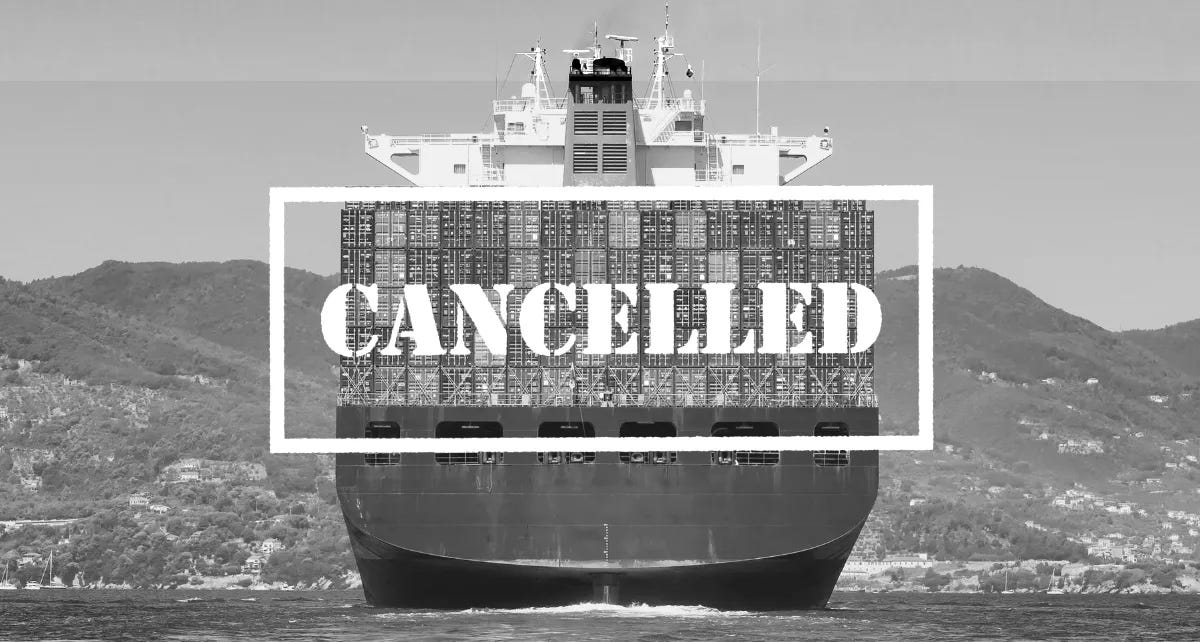
An investigation reveals how the shipping industry’s double standard allows carriers to cancel services with impunity while forwarders face consequences for the same actions
The numbers are damning. Dozens of sailings are canceled from China to the US last month. And much more in the opposite direction. These are not emergency cancellations driven by crisis. This is deliberate market manipulation dressed up as business strategy.
A recent post by Nils Walle, co-founder of RWSolutions, exposed the uncomfortable reality that few in the shipping industry want to acknowledge. “If forwarders cut services, we lose customers. When carriers do it, they call it strategy,” he wrote. The statement ignited a firestorm of responses that reveal the deep structural imbalances in global shipping.
Welcome to liner shipping 2026, where blank sailings have become the industry’s favorite tool for artificial scarcity.
The Mechanism of Control
The term “blank sailing” sounds technical and benign. The reality is far more calculated. Carriers cancel scheduled voyages not because of operational necessity, but because margins are below breakeven and demand is soft. Instead of adjusting their business models, they pull their favorite lever: cut capacity, tighten the tap, and call it “rate stability.”
Tim Gundlach at a US logistics firm cut through the euphemisms. “They are a cartel, all acting together,” he stated bluntly. The accusation is serious, but the evidence supports it.
Fresh data shows cancellation rates higher than during COVID. But this time there is no global pandemic forcing the hand of carriers. Margins are under pressure, and carriers are responding by manufacturing scarcity.
“COVID taught the carriers: disruption equals dollars,” observed Steven Gibbons at Austorient Freight. “Largest profits in history. Now there is a cry for significant losses. Down from USD 10 billion to a meager USD 8.9 billion profit.”
The scale of those profits reveals the motivation. When disruption proved lucrative during the pandemic, carriers learned that controlling supply could be more profitable than competing on service.
The Double Standard
The most striking aspect of this pattern is the glaring double standard between how carriers and forwarders are judged for identical actions.
“When forwarders adapt, it’s called desperation. When carriers manipulate, it’s called market discipline,” said Jose Coronel at All Trans Cargo. “The double standard couldn’t be clearer.”
Evan Ford at GLI provided additional context. “There’s definitely a double standard when it comes to how forwarders and carriers are judged. When carriers pull capacity it’s ‘strategy.’ When forwarders adjust it’s ‘poor service.’ But the reality is carriers control the supply side. When rates drop below cost cutting sailings is their only real lever to keep things stable. Forwarders don’t have that option. If we cut service we lose customers plain and simple.”
The asymmetry in power is stark. Forwarders operate in a fragmented, highly competitive market where thousands of companies compete for business. Carriers operate in a consolidated oligopoly where a handful of mega-alliances control global capacity.
Rohit Singh at Zipaworld summarized the frustration. “When we adjust, it’s bad service. When they adjust, it’s smart economics. Double standards sail faster than any vessel these days.”
The Asset Ownership Defense
Defenders of carrier practices point to a fundamental difference: asset ownership. Carriers own billions of dollars worth of ships. Forwarders are intermediaries. This distinction, they argue, justifies different treatment.
Frank Hellberg made this point directly. “There is a huge difference between an asset light service provider and a heavy asset company, may be some food for thought.”
The argument has surface appeal. Carriers do face enormous capital costs. Operating container ships requires massive investment. But does capital intensity justify market manipulation?
Aditya Modi at Globus Transitos defended the business rationale. “Any business owner would want there capex heavy asset to return good numbers. Apart from that no owner would want there asset to be underutilised in case of weak demand. Even large scale factories reduce their production capacity during weak demand. As you mentioned, margins are negative. Which business owner would like this scenario to run an asset with negative numbers? None. Long term its not sustainable. This is the reason carriers like Hanjin went bankrupt.”
When Asset Management Becomes Market Manipulation
The question is not whether carriers have the right to manage their assets profitably. The question is whether coordinated capacity cuts by an oligopoly cross the line from asset management into market manipulation.
Andrew Konovalenko at Keen & Able Logistics raised the legal implications. “When forwarders got together to control market that was labeled as price fixing and received huge fines. I don’t understand why when railways do it or lines buy other lines they do not get burnt for monopolizing or price fixing when removing sail as that is and should be illegal as they are forcing shortage and causing increases.”
Glenn Hayes echoed the concern. “I have always wondered why there is nothing in the competition commission about blank sailings.”
The parallel to other industries is instructive. When trucking companies coordinate to reduce capacity and increase rates, regulators investigate. When airlines collude on pricing, governments intervene. But when ocean carriers collectively manage capacity across global trade lanes, analysts call it “market discipline.”
Ken Davis pointed to the accountability gap. “Just business as usual when you have no accountability to anyone but shareholders. 2025 is not unique.”
The Cost of Deception
Beyond the economics lies a more insidious problem: deception. Christian Raeuber identified a practice that crosses ethical lines. “For me the topic is not about a business decision of the carrier, totally fine with me. But the issue is that even during the time of sale the carrier already knows it’ll cancel a sailing but still sells an ETA that is fake just to get the shipment. No carrier will close deal if they said 60 days transit. And the cost of delay is being outsourced to the shipper and consignee who would have probably been happy to pay for a premium for an on-time arrival.”
This is where operational flexibility becomes fraud. Carriers sell capacity they know they will not provide, collect the revenue, then cancel the sailing after securing the booking. The customer bears the cost of delay while the carrier avoids the cost of operation.
Henk Evelaar at HenX described the daily reality. “On a daily basis we are confronted with severe delays, blank sailings and omitted ports. The shipper pays the price, while the liners hide behind general conditions. Communications are at an absolute low, online info is not up to date and liners are not responsive to our cries for help, in fact charge us extra for COD that we require due to the liner’s failures. The larger in size, the harder it is for them to provide proper customer service. Horrible service of arrogant bullies that are too big to be held responsible.”
The Market Power Question
Several respondents challenged whether this constitutes unfair market power or simply reflects supply and demand dynamics.
Nikki Jensen posed the question directly. “Are you complaining that the carriers are reducing supply in response to demand? Or is it just because it’s called something else? Let’s assume you produce butter, and due to oversupply in the market, the price drops. Would you just keep producing more butter and increase your losses? Isn’t this simply market forces at work?”
These arguments would be more compelling in a competitive market. But the shipping industry is not competitive in the traditional sense. Decades of consolidation have created an oligopoly where a handful of players control the majority of capacity on major trade lanes.
Walle responded to this defense in the comment thread. “Fair point and yes, seasonality like Chinese New Year always plays a role. But the pattern here goes beyond that. When blank sailings start well before holidays, stretch across multiple trade lanes, and coincide with attempts to ‘restore rate stability,’ it’s not just demand fluctuation, it’s deliberate capacity control.”
He continued: “During COVID, blank sailings didn’t cause $30K per container alone, but they absolutely amplified it by tightening space when demand surged and was badly needed. Everyone made mad money of course, freight forwarders included, but at what cost and expense? That’s the real point: selective supply management that only one side of the industry can pull off without consequences.”
The Oligopoly Problem
Ricardo Martinez Hoffmann at Manreefer provided historical context. “Leading media outlets and journalists such as Lloyd’s List, Alphaliner, G. Miller, and Sam Chambers, along with respected shipping economists like Olaf Merk and Rafael Llerena, have written extensively many years ago about the consequences of the liner consolidation process and the emergence of an oligopoly.”
The consolidation has fundamentally changed market dynamics. When there were dozens of carriers competing, no single company could manipulate capacity. Today, when three major alliances control the vast majority of capacity on key routes, coordinated capacity management becomes possible.
Mustafa Badshah at DP World acknowledged the reality. “It’s definitely a business move. Most industries have top players who can shape the market like this. Honestly, if forwarders could, they probably would too, but they can’t afford to cut services. Too many players, no unity, and customers would just go elsewhere.”
La C. at Oscar Track provided a freight forwarder’s perspective. “Us forwarders even the smallest are diversified enough where it isn’t a one-horse race. There are also millions of us to self-cannibalize and take our place. We are heavily unregulated and barrier to entry is so low that we are not considered professionals. In short we are all expandable and easily replaced. Carriers are totally opposite.”
The Transparency Problem
Even those who accept the business rationale for capacity adjustments acknowledge that transparency is lacking.
Evan Ford at GLI suggested a path forward. “At the end of the day it’s less about fairness and more about transparency. If carriers communicated these blank sailings as planned resets instead of surprise cancellations there’d be a lot more trust across the board.”
Aaron Poole at BR International identified the core issue. “The ‘discipline’ narrative has become the industry’s polite way of saying ‘we’ll manage profits, not performance.’ When forwarders streamline, it’s called ‘service erosion.’ When carriers cancel sailings, it’s called ‘capacity management.’ Same move, different PR. The irony is, true stability comes from reliability, not artificial scarcity. Customers don’t want volatility dressed as control. They want trust, consistency, and honesty in the chain.”
The Economic Reality
Not all critics dismiss the economic pressures carriers face. Len Phillips warned of the alternative. “And if shipping lines run deficits and collapse, all tonnage is gone and rates would rise faster than a measured adjustment to tonnage. Then there would be more complaints about pricing. The real issue is that no one wants to pay sustainable rate right across the supply chain leading to asset management that causes disruptions.”
Aaryav Gupta at Pridel made a similar point. “If carriers don’t do blanks to maintain the rates, we all would be going blanks with our bank accounts. I mean it really doesn’t make sense to operate below a certain number and it’s their asset, they have to make money over the huge cost invested. If there are no blank sailings, all we will see is $250 per 40-foot container from Asia to Europe and that my friend is not good for anyone.”
The economic tension is real. Carriers need sustainable returns. But the question remains whether coordinated capacity cuts by an oligopoly represent fair market adjustment or market manipulation that harms the broader supply chain.
The Path Forward
The question is whether regulators will finally acknowledge what the industry already knows: blank sailings are not just business decisions. They are tools of market control that only one side of the supply chain can wield without consequence.
Until that changes, forwarders will continue to bear the blame for delays caused by carrier decisions, customers will pay inflated rates justified by artificial scarcity, and the double standard will persist.
As one industry observer noted, “When we adjust, it’s bad service. When they adjust, it’s smart economics.”
The shipping industry has learned to profit from disruption. The only question now is how long regulators will allow it to continue.
Join the conversation on global supply chain transparency and accountability at Chain.NET, where logistics professionals debate industry practices, share insights on market dynamics, and connect at events focused on building a more equitable supply chain. The discussion continues beyond the headlines.
