

The New Rules of Global Sourcing: How Automation and Geopolitics Are Reshaping Fashion Supply Chains
A veteran sourcing executive shares hard-won insights on navigating factory floors, tariff wars, and the technology transforming apparel manufacturing
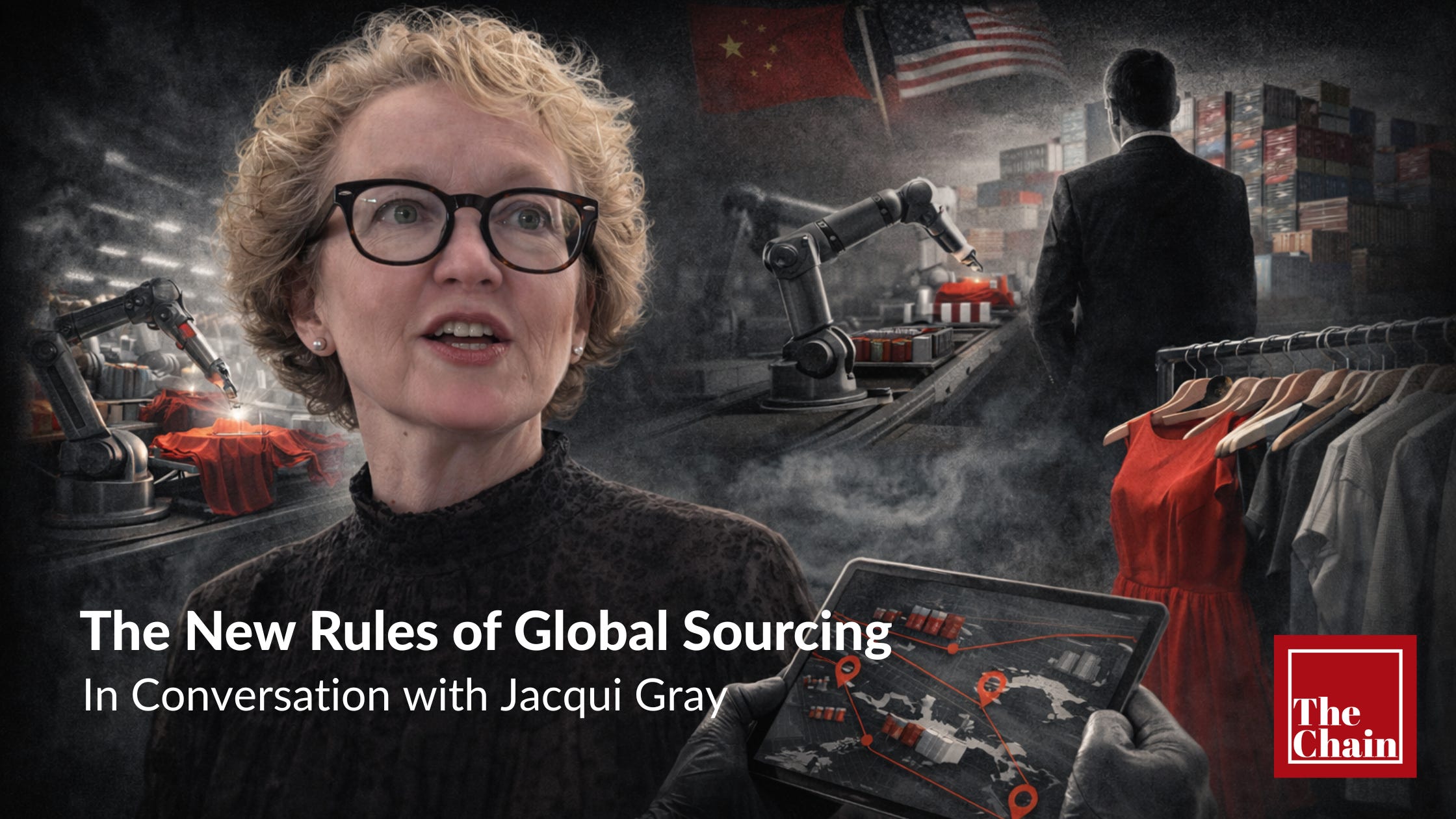
The sewing machine operator in Guangdong Province is 55 years old. Her colleagues are aging too. Young workers don’t want factory jobs anymore. They prefer service industries, office work, anything but sitting at a production line.
This demographic shift is quietly revolutionizing how fashion gets made.
Jacqui Gray has spent 20 years navigating the global sourcing landscape. She started her career at Tesco’s first international sourcing office in Bangladesh in 2005. Today, she oversees production across China, Bangladesh, and emerging markets for a major fashion retailer. In a recent interview with Paul Lennen, host of The Sourcing Exchange, Gray offered a rare look at the forces reshaping apparel manufacturing.
“What we’ve observed, especially since COVID, is this aging workforce in factories,” Gray told Lennen. “I was getting quite worried about the future of garment making in China. Then we started seeing these machines on the production floor.”
The Automation Revolution Arrives
Walk into a Chinese garment factory today and you’ll find machines four to five times the size of traditional sewing equipment. Automated needles follow programmed templates. The system folds fabric, turns pieces, and stitches with precision no human hand can match.
“It takes away the need for skilled labor,” Gray explained. “Now you just need someone who places fabric into position. The machine does all the sewing beautifully. It works 24/7.”
The numbers tell the story. On a piece of outerwear, 60% to 70% of production now runs through automated machinery. Denim jeans have reached similar levels. Only the major seams still require manual work.
China leads this transformation by necessity. When young people won’t enter factories, owners invest in robots. But the technology is spreading. Gray spotted automated machinery in Bangladesh last week and in Madagascar earlier this year.
“Where you’ve got Chinese knowhow in factories, you will start to see these machines,” she said. “What started as a real need in China because of the labor crisis moves into an efficiency opportunity for other countries.”
Tariffs Reshuffle the Deck
The past year threw another variable into the sourcing equation. U.S. tariffs forced brands and suppliers to make hard choices about geographic footprints.
“It’s been a year of navigating who’s leading the decisions,” Gray said. “Most of our suppliers are not too dependent on the U.S., but some are. A Chinese supplier whose business is 60% American has seen volume drop this year.”
The obvious alternatives aren’t so obvious. Egypt now enjoys lower duty rates from the U.S., making it potentially attractive. But setting up denim manufacturing and laundry operations requires years, capital, training, and expertise. Production capacity doesn’t materialize overnight.
“Some of the changes don’t happen as fast,” Gray noted. “The suppliers working with the U.S. are still working with the U.S., but strategic changes will carry on over the next five years.”
Gray sees two supplier archetypes emerging. Some pursue the hub-and-spoke model, adding production in Egypt or other markets to their existing China-Vietnam-Cambodia networks. Others double down on their home base, investing in automation and efficiency rather than geographic expansion.
Both strategies carry risk. Both require capital. Neither offers guarantees.
The Impossible Pentagon
Sourcing executives face what Gray’s industry calls “the impossible pentagon.” Every decision involves trade-offs between carbon footprint, social compliance, cost, quality, and supply chain agility.
“Trying to get the best outcome across all five is impossible,” Gray said. “It comes back to finding the optimal balance.”
That balance shifts constantly. Fabric prices face downward pressure as retailers seek to protect margins. Sustainability regulations from the European Union demand new compliance infrastructure. What started as tracking 60 tier-one factories now extends to 450 suppliers across multiple tiers.
“The challenge is the tier twos, threes, and fours,” Gray said. “They haven’t necessarily been engaged by legislation. They haven’t measured things in certain ways.”
Water usage and chemical management have become priority areas. The data collection requirements alone require dedicated staff. Technology solutions exist, but the market remains fragmented. Gray’s company hasn’t committed to a platform yet, watching which providers will survive and grow.
What AI Can and Cannot Do
Artificial intelligence hasn’t cracked the sourcing code. Gray tested it on practical questions. The results disappointed.
“I was looking for a particular news source in Bangladesh on a particular product,” she said. “The answers were really not credible.”
AI performs better on economic parameters and general data. It offers reasonable suggestions for institutions to contact when exploring new markets. But it can’t replace the detective work, relationship building, and on-the-ground intelligence that define effective sourcing.
“Traditional ways of using your detective skills absolutely still matter,” Gray said. “Use AI as one of the tools. By no means rely on it.”
The Character It Takes
Gray’s path into sourcing started with a geography degree focused on people, locations, and developing countries. A chance conversation with a linen company executive who had just returned from three years in China sparked her ambition.
Getting there required what she calls “bravery.” Her mother warned about snakes during floods and arsenic in the water supply. Gray went anyway, landing in Dhaka in 2005.
“You leave behind family and friends,” she said. “You have to adjust, figure out how to survive, then succeed when you’re up against people you don’t know, working with suppliers, working with all the problems and challenges.”
The job offers no routine. Last week meant factory visits in Bangladesh dealing with production challenges. Next week brings 20 buying meetings in China over three weeks. The landscape feels different every six months.
“Speed matters when it comes to finding margin opportunity,” Gray said. “You have to see it, sense it, and do it.”
Key Takeaways
Automation solves labor problems but requires capital. Chinese factories invest in robotics because young workers won’t take manufacturing jobs. The technology improves quality and runs continuously, but suppliers need volume and long-term business relationships to justify the investment.
Geographic diversification takes longer than headlines suggest. Tariffs create incentives to shift production, but building manufacturing capability in new markets requires years of investment, training, and infrastructure development.
This article is based on an interview conducted by Paul Lennen, host of The Sourcing Exchange. Watch the full conversation here.
What’s your experience with sourcing transformation? Are you seeing automation change your supply base? How are you balancing the impossible pentagon of cost, quality, sustainability, speed, and compliance?
Share your perspective in the comments or continue the discussion on Chain.NET.
 | A guest post by
|