

When the Consultancy Eats Itself: What McKinsey’s AI Pivot Means for Supply Chain Advisory
Why the death of the billable hour reshapes how supply chain leaders should buy consulting.
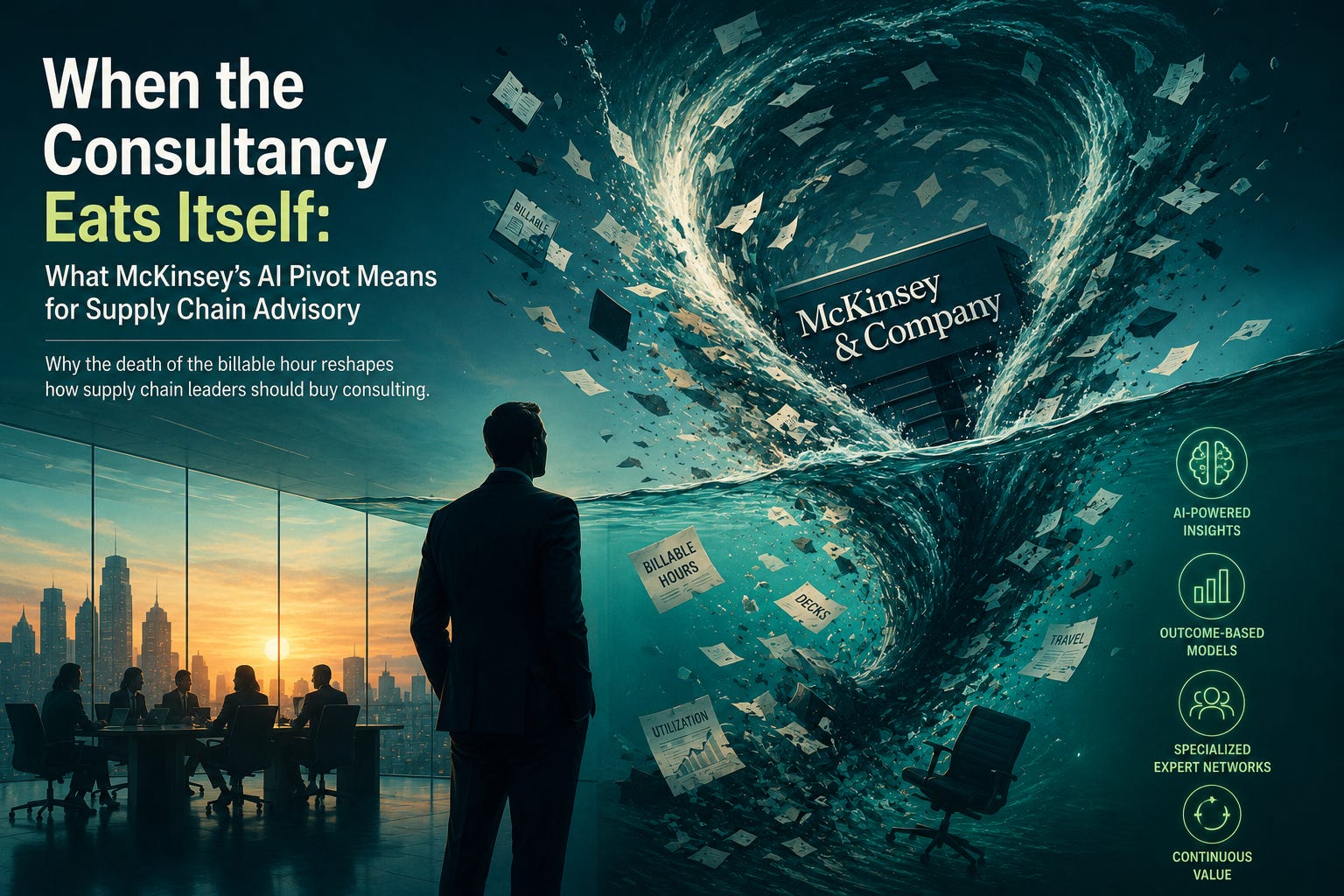
The most profitable consulting firm on earth is restructuring its compensation model because of artificial intelligence. McKinsey reportedly now counts 25,000 AI agents alongside its human workforce, a development internally referenced as “Project Acorn.” Partners are being paid less in cash and more in locked-up equity tied to verified client outcomes that may not be realized for years. The firm famous for charging hundreds of thousands of dollars to validate decisions executives had already made is automating the junior analysts who produced the slides. The implications travel far beyond consulting itself. They land directly on every supply chain leader who has ever signed a six-figure advisory engagement.
The debate gained traction after a LinkedIn post from Craig Taggart, a venture partner focused on quantum and infrastructure, flagged the structural shift. His core argument: when AI compresses a three-week project into three days, clients stop paying for time and start paying for outcomes. The post drew CFOs, transformation directors, ex-Big Four partners, supply chain consultants, and finance leaders. The agreement on the direction was strong. The disagreements about what it actually means for buyers were sharper.
The Real Disruption: Collapsing Cognitive Scarcity
The most cited reframing came from Mark Powell, an industrial and organisational psychologist focused on human-centric AI. “Everyone is focusing on the wrong part of the McKinsey story. The real disruption is not AI replacing junior analysts. It is the collapse of cognitive scarcity.” For decades, he argued, firms monetised access to information, structured thinking, synthesis, presentation, and analytical labour. “AI has now commoditised large parts of that stack.”
His conclusion reframed the value question for every advisory buyer. “The value of human judgement is rising dramatically. Not generic judgement. Not experience alone. High-quality cognitive judgement. The ability to think independently, challenge machine output, tolerate friction, maintain attention, make decisions under ambiguity, synthesise weak signals, avoid automation bias.” Once execution becomes infinite and cheap, cognition becomes the competitive advantage.

Continue reading this post for free, courtesy of Global Supply Chain Council.
 | A guest post by
|