

When the Referee Gets Red-Carded: Gartner’s Consulting Rankings Under Fire
Gartner ranks the consulting giants. But who ranks Gartner? Investors already have, and the verdict is brutal.
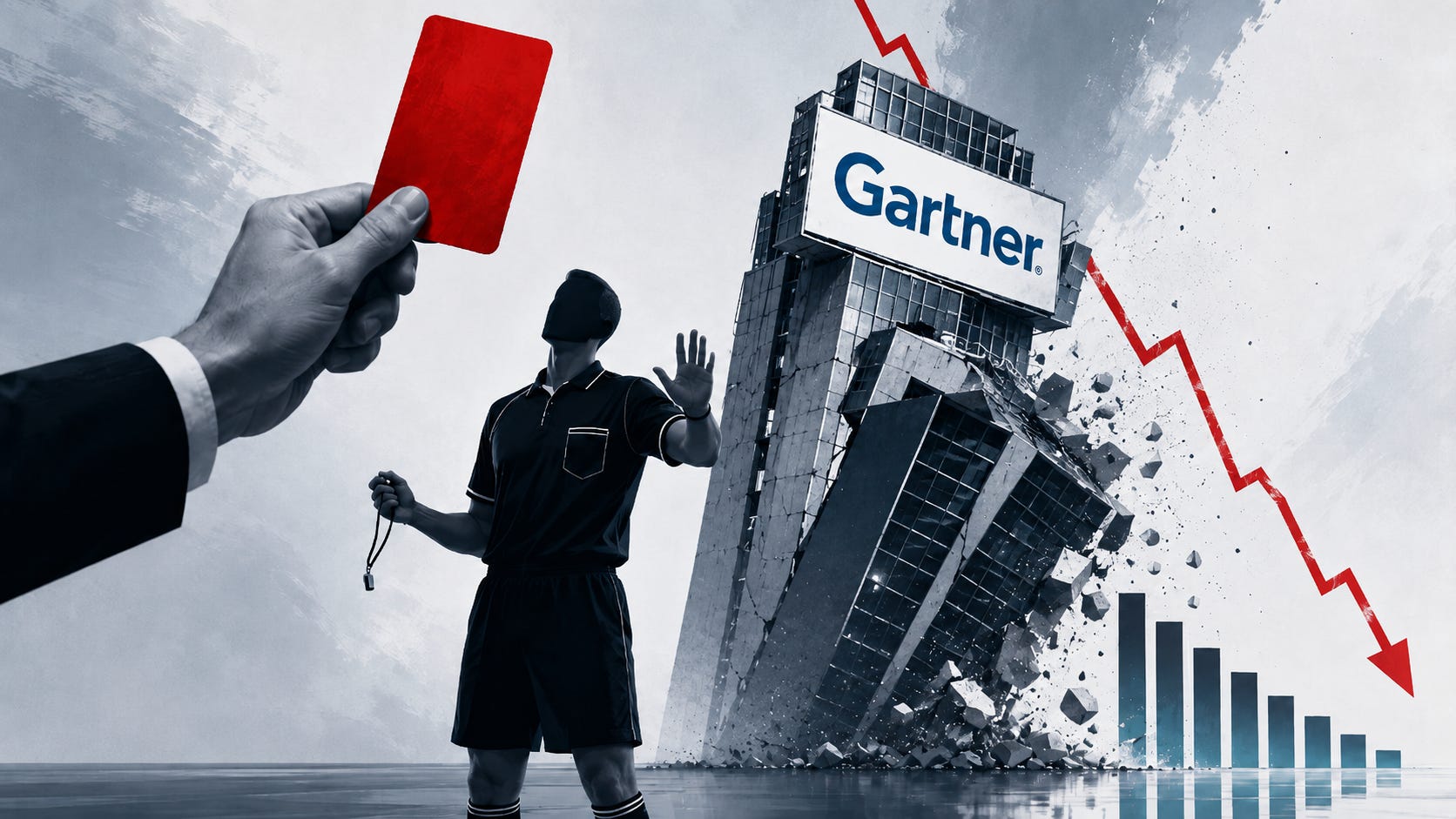
Gartner has entered a new market at a curious moment. Recently, the research giant published its inaugural Magic Quadrant for Supply Chain Strategy, Planning and Operations Consulting. The verdict placed Accenture, Deloitte, McKinsey, and PwC in the Leaders quadrant, EY as a Challenger, BCG as the lone Visionary, and Bain, Capgemini, and KPMG as Niche Players.
The report, authored by Gartner analysts Michael Dominy and Caleb Thomson, replaces the previous Market Guide format with a full Magic Quadrant. Gartner justifies the shift by citing a market with “clearer competitive differentiation and repeatable product-and-service models.” But the timing invites scrutiny. This new quadrant arrives from a firm whose stock has collapsed roughly 64% over the past twelve months, whose shareholders have filed a securities fraud class action, and whose credibility is being openly questioned by the practitioners who once treated its research as gospel.
A Ranking Firm in Freefall Ranks Others
The numbers tell a stark story. Gartner shares closed at $132.69 on July 9, 2026, down from a 52-week high of $409.76 and an all-time peak of $551.80 in November 2024. The stock touched a 52-week low of $124.25 in late June, just days after this Magic Quadrant published. Market capitalization has shrunk from over $40 billion at its peak to roughly $9 billion today. First quarter 2026 revenue actually declined 1.5% year over year, and analysts keep cutting price targets, with some estimates falling from around $253 to under $200.
Worse, a securities fraud class action now covers investors who bought Gartner stock between February 2025 and February 2026, alleging misleading disclosures about contract value growth and Consulting segment performance. The referee handing out consulting rankings is itself accused of misleading the market about its own consulting business.
Supply chain advisor Anna McGovern, author of Antifragile Supply Chains, diagnosed the underlying cause when the decline began: “AI has commoditized good-enough research and slideware. Clients no longer want PDFs after the fact. They want answers in the workflow.” Rich Sains, a procurement transformation leader at Qatar Airways, captured the shift in one sentence: “In the past, as an IT procurement leader I would have asked a Gartner analyst. Now I would ask ChatGPT, Claude or Gemini.”
A Referee With Skin in the Game
Gartner’s business model creates an obvious tension. The firm generates revenue from research subscriptions, advisory services, event sponsorships, and reprint rights, much of it flowing from the very companies it evaluates. Firms ranked as Leaders purchase reprint licenses to promote their positioning. The report itself carries a “Licensed for Distribution” marking.
Gartner insists its research is “produced independently by its research organization without input or influence from any third party.” Industry veterans have grown skeptical. David Linthicum, a prominent cloud and AI strategist and former CTO, describes the model bluntly as “quintessential pay-to-play, almost legalized extortion.” In his words, “enterprises felt obligated to subscribe just to keep up, while vendors felt a quadruple obligation to funnel money into Gartner’s coffers for the privilege of getting featured.”
One French entrepreneur, Eric Wanscoor, put a number on it, recalling that entry into Gartner’s analyses once required roughly 45,000 euros for a startup. Marketing strategist Shelly DeMotte Kramer describes companies “begrudgingly having to pay the Gartner tax and play the game, being held hostage to a relationship that doesn’t deliver real value.”
The consulting quadrant intensifies these concerns. Consulting firms are among the most sophisticated analyst relations operators in the world. When the evaluated firms are also masters of managing the evaluator, the rankings risk measuring analyst relations skill rather than client delivery quality.
A Methodology Built on Self-Reporting
The evaluation criteria reveal structural weaknesses. Much of the underlying data comes from the vendors themselves. Gartner evaluated “the trends that the vendor sees in the market,” “how the vendor approaches customer experience,” and “the vendor’s talent and retention.” Consulting firms have every incentive to present these favorably.
The report even admits its data gaps. Gartner notes that “several providers withheld granular commercial metrics or long-term scale targets” and that “concrete, large-scale production examples of agentic AI remain less common than roadmaps and pilots.” Read that carefully. Providers withheld key data, and pilots got counted alongside production deployments. What exactly is being measured?
The AI emphasis creates circular logic. Every vendor profile celebrates agentic AI, digital twins, and proprietary platforms. Yet Gartner’s own analysis admits these capabilities remain largely unproven at scale. Firms get ranked on promises and polished narratives rather than demonstrated outcomes.
This pattern has history. Linthicum documented multiple Gartner predictions that missed badly, including the forecast that 80% of enterprises would use cloud computing for mission-critical workloads by 2015, a milestone that stretched well into the 2020s. Gartner itself warned that 85% of AI projects would fail to deliver, and now projects that over 40% of agentic AI projects will be canceled by end of 2027. The firm rewards consulting vendors for the very AI visions its own research suggests will largely disappoint.
Arbitrary Gates and Visibility Loops
The inclusion criteria embed structural biases. To qualify, firms need $5 billion in total revenue, at least 1,000 supply-chain-focused consultants, and at least 60% of consultant headcount in North America and Europe. A firm delivering exceptional supply chain consulting primarily in Asia-Pacific fails by design, regardless of quality.
One criterion stands out: providers must appear as a “top 50 vendor for Gartner inquiries.” A firm’s eligibility partly depends on how often Gartner’s own clients ask about it. This creates a visibility feedback loop that rewards incumbency. Firms prominent in Gartner’s ecosystem qualify for evaluation, which increases their prominence, which reinforces eligibility.
Experienced practitioners also question the quadrant’s basic architecture. Erich Gampenrieder, a supply chain leader with nearly three decades across Accenture, Deloitte, KPMG, and Genpact, argues the traditional separation of strategy, planning, and operations “is becoming obsolete.” Planning, he contends, now “connects business strategy, enterprise architecture, technology, transformation, and operations into one integrated management capability.” Dirk Holbach, a Chief Supply Chain Officer with deep transformation experience, agreed on the orchestration point while adding that he “would have some different perspective on the Gartner assessment in terms of who sits where.” When practitioners question both the framework and the placements, the rankings deserve caution.
Executive Cover, Not Insight
Even the function of the rankings gets questioned. Technology executive Tim McConnaughy describes the Magic Quadrant as “an insurance scheme,” where executives buy the ranking so that “when the dust settles they can say, I bought the Magic Quadrant, it’s not my fault.” Linthicum recalls clients admitting they made technology decisions they doubted because “this is what Gartner recommended,” protecting careers rather than companies. Thomas Audibert, a French procurement technology founder, describes the model as “a self-reinforcing loop: vendors pay Gartner, Gartner validates, executives feel safe.”
A ranking that functions primarily as executive cover measures nothing about delivery quality. It sells absolution, not insight. Consultant Miroslav Pitlanic sharpened the point: Gartner “got comfortable selling answers when the market started valuing questions.”
Gartner’s own recommendations quietly undermine its quadrant. The report advises buyers to interview proposed staff, secure approval authority over team members, and demand that acquired specialists staff projects because “the acquired firm, not the large global provider, has the specialized expertise.” It concedes that expertise “varies by geography” at Accenture, is “more mature in North America” at Deloitte, and “differs by region” at KPMG. If quality varies this much within each firm, a single quadrant position tells a buyer almost nothing about a specific engagement with a specific team.
A Different Model Is Possible
The deeper lesson is that vendor and provider evaluation needs a new foundation, one where placement cannot be bought and where the methodology serves buyers rather than the ranked. This is exactly the gap the Global Supply Chain Council is addressing with the GSCC Vendor Radar (radar.gscc.app), a supply chain software vendor discovery tool built on a strict editorial independence rule: no paid placement, ever. Vendors cannot buy their way onto the radar or into a better position. Instead of abstract two-by-two axes, the Vendor Radar organizes solutions around four buyer-job quadrants that reflect what practitioners actually need to accomplish, and every listed vendor passes through a verification pipeline before appearing.
The premise is simple. When the evaluator takes no money from the evaluated, buyers can finally trust what they read. And the model is designed to travel. GSCC is exploring extending the same independent, verification-based approach to a Consulting Radar, applying the no-paid-placement principle to the very market Gartner just attempted to map. If consulting firms want visibility with buyers, they would earn it through verified capabilities and practitioner feedback, not analyst relations budgets.
Key Takeaways
Gartner’s inaugural consulting Magic Quadrant arrives from a firm in crisis. The stock has lost roughly 64% of its value over the past year, while a securities fraud class action alleges misleading disclosures about the very contract value and consulting metrics that underpin its credibility.
The methodology relies heavily on vendor self-reporting and rewards AI roadmaps over proven results. Gartner admits providers withheld commercial data and that production-scale agentic AI examples remain rare, yet AI vision features prominently in the rankings. Given Gartner’s documented history of missed predictions, buyers should discount vision-based placements heavily.
The structural conflicts are unresolved. Reprint revenue, the “Gartner tax,” visibility-based inclusion criteria, and arbitrary revenue thresholds mean the quadrant measures analyst relations prowess and incumbency as much as delivery quality. Practitioners increasingly bypass analysts entirely, asking AI tools the questions they once paid Gartner to answer.
Independent, verification-based models with no paid placement, like the GSCC Vendor Radar and a potential future Consulting Radar, point to where provider evaluation is heading. Treat any quadrant as a starting longlist, then rely on staff interviews, sample deliverables, and independent references to make the actual decision.
Do you still rely on analyst rankings when selecting consulting partners, or have AI tools changed how you research providers? Would a no-paid-placement model like the GSCC Vendor Radar, extended to consulting firms, earn your trust faster? Share your perspective in the comments below.
 | A guest post by
|