

Your Supply Chain Spent Five Years Building Resilience. It Got Complexity Instead.
New research reveals 12% to 18% of supply chain cost is now structurally hidden. A four-module diagnostic framework helps leaders find it.
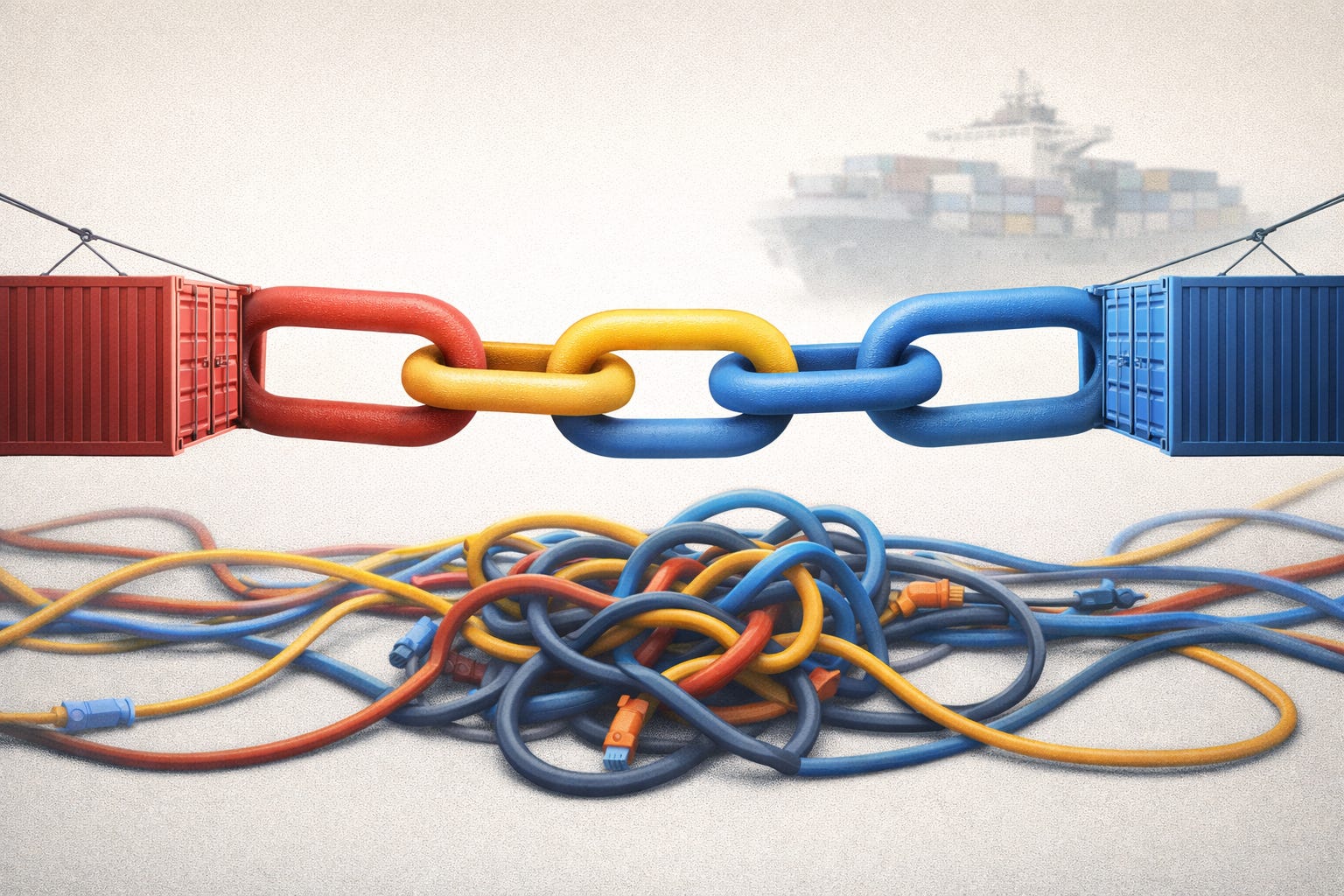
Every supply chain decision between 2020 and 2025 made sense at the time. Nearshoring to reduce dependency on a single region. Dual-sourcing to protect against supplier failure. Inventory buffers to absorb demand swings. Digital monitoring tools to see further ahead.
A recent study from HFS Research, authored by Ashish Chaturvedi, Executive Research Leader covering supply chain operations and retail, puts a number on what those decisions actually produced. The firm estimates that 12% to 18% of supply chain cost in consumer goods companies is now structurally hidden. It does not appear in any single budget line. It lives in inflated cost-to-serve on long-tail SKUs, redundant warehousing for promotional inventory, and carrier fragmentation across channels.
HFS calls this “structural complexity drift.” The gradual accumulation of redundant nodes, overlapping capabilities, and conflicting optimization targets. Each layer added during the disruption years was individually rational. Collectively, they created architectures that are more expensive, slow to adapt, and hard to govern.
The data makes the point sharply. Complexity creates three compounding effects. First, cost leakage at 12% to 18% that hides across budget lines. Second, decision latency that slows every choice touching the supply chain by a factor of three to five. Third, what HFS calls “resilience theater,” where organizations maintain eight backup co-packers and five demand-sensing platforms but cannot activate the right response when a key retailer changes order patterns. Redundancy without coherence is not resilience.
The pattern extends well beyond consumer goods. Any company that expanded its supply chain footprint during the disruption years faces the same structural question. Where did we add capability, and where did we just add cost?
Five domains where complexity concentrates
HFS identifies five domains where supply chain complexity tends to concentrate: Network, Supplier Base, Product and SKU, Process and Planning, and Technology and Data. Each has distinct causes, symptoms, and cost profiles.
The Product and SKU domain carries disproportionate weight. SKU proliferation, promotional complexity, and retailer-driven assortment requirements compound on each other. One question from the HFS diagnostic makes the point: if you eliminated the bottom 20% of SKUs by revenue contribution, how would your supply chain cost structure change? Most leadership teams know the answer intuitively. Few have run the numbers with full supply chain cost loaded in.
In Process and Planning, the research highlights a simple test: how many hours per week does your planning team spend reconciling data versus making decisions? If the answer is more than 20, complexity has eaten your planning capacity.
Technology and Data is equally revealing. How many systems in your organization produce a version of “demand forecast”? Which one does leadership trust? If you built your supply chain tech stack from scratch today, how much of the current stack would you replicate?
From diagnosis to action
The HFS framework provides a structured path through four modules. Module 1 is the complexity diagnostic itself, scoring each domain across cost impact, resilience impact, and decision impact. Module 2 offers a library of seven rationalization levers across four intervention types: Eliminate, Consolidate, Standardize, and Automate. Module 3 compares three scenario archetypes (Surgical at 6 to 12 months, Accelerated at 12 to 24 months, Structural at 24 to 36 months) and produces a decision-sequenced roadmap. Module 4 establishes governance.
The governance module matters more than most leaders expect. HFS found that organizations that rationalize successfully but skip governance see 60% to 80% of complexity return within 18 to 24 months. Each addition is small. A new co-packer for a retailer-exclusive SKU. A line extension launched without a corresponding retirement. A planning tool adopted by one region. Collectively, they reconstitute the complexity that was rationalized.
The research frames governance around four pillars: complexity budgets with hard limits per domain, quarterly rationalization reviews with decision authority, clear decision rights specifying who can add complexity and who is accountable, and incentive alignment ensuring that performance metrics do not reward volume additions without accounting for cost-to-serve.
What leadership teams should take away
First, complexity is not a feeling. It is measurable. Score your organization across the five domains and you will see where the hidden cost concentrates.
Second, the highest-ROI moves are often subtractive. Exiting tail suppliers, retiring underperforming SKUs, and compressing planning cycles deliver faster results than adding new tools or platforms.
Third, governance is not optional. Without it, rationalization is a project with a start and end date. With it, rationalization becomes an operating discipline.
How much of your supply chain architecture was built in response to a disruption that has already passed? What would you change if you scored each domain honestly?
Try the free diagnostic
The GSCC Decision Lab has adapted this framework into a free self-assessment tool. Score your five complexity domains in 10 minutes and get your complexity radar, heat map, and priority ranking at https://complexity.gscc.app.
GSCC members get the full Excel toolkit on the Decision Lab: scoring worksheets with conditional formatting, the complete lever library, scenario comparison frameworks, decision-sequenced roadmap templates, and the governance operating model. Start your 14-day free trial at www.chain.net/checkout/individual-membership. No credit card required. See all benefits at https://gscc.co/benefits.
We want to hear from you. Share your feedback, your scores, and your experience with supply chain complexity.
Continue the discussion on Chain.NET, the global supply chain community, at www.chain.net. Ask questions, join events, and access exclusive resources.
 | A guest post by
|